
bookgpts-interactive-literary-adventures
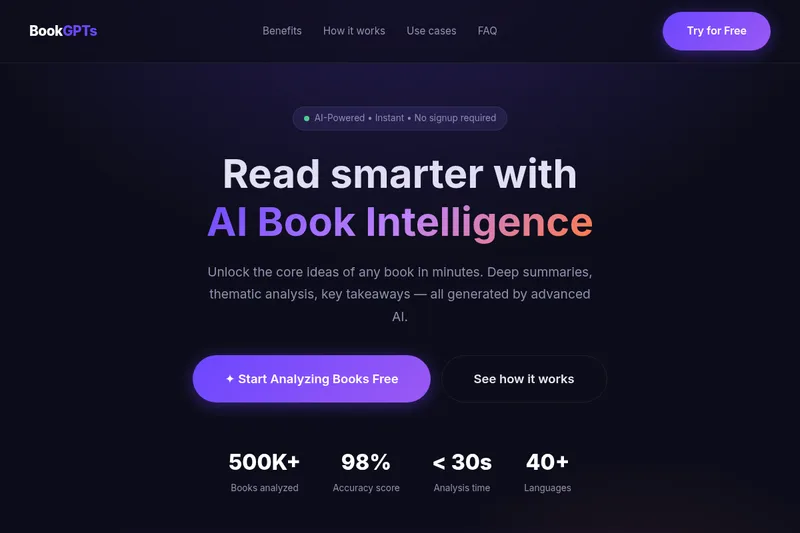
Book-GPTs turns a book title, author, or topic into an AI-generated summary and analysis, with follow-up questions for readers. Students, researchers, analysts, and teams can use it to review ideas more quickly.
Who it's for
- Students and academics who need to get oriented to assigned readings or map arguments for essays.
- Researchers, analysts, and consultants who want to survey literature and extract data points before checking primary sources.
- Teams and managers who want to share book insights and build common frameworks for strategy or leadership.
How it fits your workflow
Enter a book title, author, or topic, then select a quick overview, detailed chapter analysis, or thematic deep-dive.
Read the generated analysis, ask follow-up questions, explore themes or claims, and save insights to a personal knowledge library.
Pricing
Free: The page says book analysis, summaries, and follow-up questions are free. It does not state a price for the Pro plan.
Free
Free
- · Analyze books
- · Get summaries
- · Ask follow-up questions
Pro
Price not stated
- · Full chapter-by-chapter analysis
- · Book comparison
- · Team sharing
Prices checked on Nov 15, 2026 from the vendor's site. They can change; confirm before you buy.
Key features
- Book summaries and chapter analysis
- Generates a quick overview or a more detailed chapter-by-chapter breakdown, including a book's core arguments and author thesis.
- Thematic analysis
- Identifies recurring themes and philosophical underpinnings, and can connect ideas across disciplines.
- Interactive questions
- Lets users ask questions about a book, request examples, challenge claims, or examine a specific concept.
- Actionable takeaways
- Surfaces five ideas from an analysis that the page describes as likely to change how a reader thinks.
- Book comparison
- Enables users to compare books, contrast arguments, and discover connections between authors.
- Concept mapping
- Provides a visual breakdown of how ideas connect within a book, from premise to conclusion.
Limitations to know
- Full chapter-by-chapter analysis, book comparison, and team sharing are listed as Pro features rather than free features.
- The page advises users to cross-reference primary sources when using the service for citation purposes.
Alternatives to consider
-
Myreader.ai
Choose it if you want to upload books, PDFs, documents, article links, or YouTube videos and use searchable citations or audiobook conversion, rather than start with a book title for analysis.
Getting started
- Enter a book title, author, or topic.
- Choose the desired analysis depth.
- Read the results and ask follow-up questions.
- Save useful insights to the personal knowledge library.
Frequently asked questions
How accurate are the book analyses?
The page says analyses are structured around book content and reports over 98% alignment with professional reviews for popular titles. It describes the AI as trained on literary criticism, academic papers, and reader reviews.
Does Book-GPTs replace reading the actual book?
The page says it depends on the reader's goal. It can help someone decide whether a book is worth reading or grasp its ideas for a meeting or presentation, and some users use it as a companion while reading rather than a replacement.
What types of books are supported?
The page lists non-fiction, fiction, and academic texts, and says it supports books across more than 40 languages and titles from any country.
Is it free to use?
The page says users can analyze books, get summaries, and ask follow-up questions for free. Full chapter-by-chapter analysis, book comparison, and team sharing are listed as Pro features.
How is Book-GPTs different from other summary tools?
The page describes Book-GPTs as interactive: users can ask follow-up questions, explore themes, challenge claims, and connect ideas across books.
Can it be used for academic or professional research?
The page says researchers, analysts, and consultants use it to survey literature, extract data points, and build bibliographies. It advises cross-referencing primary sources for citation purposes.