
Kodelyth ECC
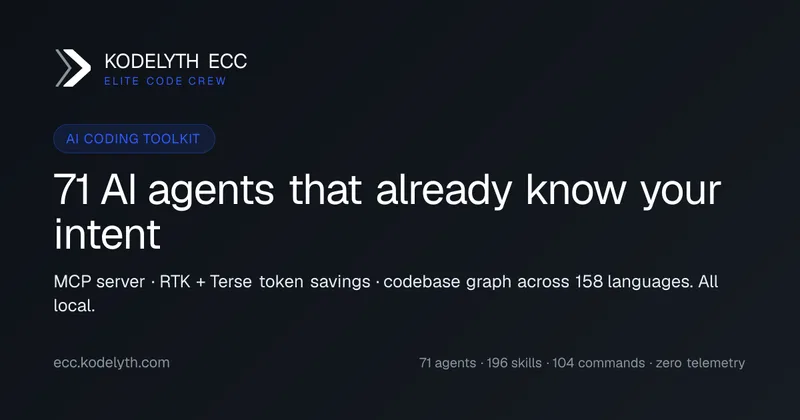
Kodelyth ECC adds specialist AI agents, orchestration, memory, and codebase analysis to AI coding workflows. Developers use it to coordinate coding tasks and reduce context and token usage across supported platforms.
Who it's for
- Developers using supported AI coding platforms who want plain-language routing to specialist agents.
- Engineering teams that need parallel code, security, performance, or API reviews.
- Developers working across recurring coding sessions who want local memory keyed to their Git remote.
How it fits your workflow
Install ECC with npm and target an AI coding platform. Once configured, describe a problem in plain language and ECC routes it to a specialist, or use parallel commands to run multiple agents together.
For larger objectives, the Super Agent decomposes work into a dependency graph, runs independent steps in parallel on separate branches, then conflict-checks, integrates, and verifies. RTK filters supported shell output before it reaches the model, while Terse mode compresses model responses.
ECC also provides a local codebase graph for structural queries and Compound Memory for capturing and recalling solutions. The MCP server exposes agents, skills, and local memory to supported applications.
Pricing
Free: Kodelyth ECC is free forever under the MIT license, with no account or subscription required.
Free
Free forever; MIT-licensed.
- · No account required
- · No subscription
- · Toolkit runs locally on the user's machine
Prices checked on Nov 12, 2026 from the vendor's site. They can change; confirm before you buy.
Key features
- Intent routing
- Routes plain-language requests, errors, frustrations, or pasted stack traces to one of 71 specialist agents. The page says routing uses 10 priority tiers and 8 confidence dimensions, and announces which agent took over.
- Parallel commands and multi-agent review
- Can run up to eight agents simultaneously. The example /team-review command brings together code-reviewer, security-reviewer, perf-optimizer, and api-guardian.
- Super Agent orchestration
- Takes a larger objective, decomposes it into a dependency graph, dispatches independent steps in parallel on separate branches, conflict-checks and integrates the results, and verifies the outcome. The process is described as resumable and budget-capped.
- Devil Mode red-team agents
- Runs eight dedicated agents to look for issues including prompt injections, supply-chain vulnerabilities, leaked secrets, and backdoors.
- RTK input compression
- An auto-installed PreToolUse hook filters shell-command output before it reaches the model. The page says it strips noise, groups and deduplicates output, and supports more than 100 commands.
- Terse output compression
- A four-level output compression setting reduces filler in model responses while preserving code blocks, commands, URLs, and paths byte-for-byte.
Works with
- AI coding platforms
- MCP-compatible applications and frameworks
Limitations to know
- The page says actual token savings depend on workload and that its monthly and yearly savings estimates are not a guarantee.
Alternatives to consider
-
ClaudeThings
Choose it if you want a packaged set of agents, skills, and slash commands delivered through a private GitHub repo and installed with a single npx command.
Getting started
npm i -g kodelyth-ecc- Install the package with `npm i -g kodelyth-ecc`.
- Run `kodelythecc --target claude-code --codebase-graph` to install it for Claude Code with the codebase graph.
- Restart your AI tool.
Frequently asked questions
Is Kodelyth ECC free?
Yes. The page says Kodelyth ECC is MIT-licensed and free forever, with no account or subscription required.
Does it work with Cursor, Windsurf, and other IDEs?
Yes. The page lists 12 AI coding platforms, including Claude Code, Cursor, Windsurf, Codex CLI, Google Antigravity, OpenCode, Cline, Roo Code, Aider, Kimi, Gemini CLI, and Kiro, and says there are 14 install targets.
Is my code sent anywhere?
The page says the agents, skills, memory store, RTK compression, and codebase graph run locally, with zero telemetry and no cloud calls.
How much does it reduce token usage?
The page reports 60–90% fewer input tokens from RTK, 40–70% fewer output tokens from Terse mode, and about 99% fewer tokens for codebase graph structural queries than file-by-file grep. It estimates a typical combined reduction of 55–65% and says actual savings depend on workload.
How do I install it?
Run `npm i -g kodelyth-ecc`, then `kodelythecc --target claude-code --codebase-graph`, and restart your AI tool.