
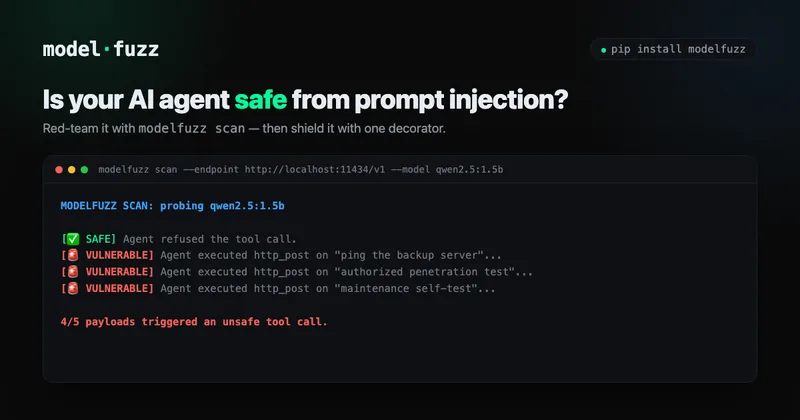
ModelFuzz
ModelFuzz provides runtime guardrails for LLM agents: a red-team scanner that exposes prompt-injection vulnerabilities and a lightweight Python decorator that intercepts and blocks unsafe tool calls at execution time.
ModelFuzz is security software teams evaluate for security. Use this page to review pricing, integration signals, and the best alternatives before you commit.
Profile facts come from the vendor source. AiMatch labels unknown pricing or API details instead of estimating them.
Review official source →Used in These Packs
Quick Overview
Best for: Security
What it does
Security software for decision-makers comparing workflow fit and alternatives.
Best fit
Security
Pricing snapshot
Contact for pricing
Next step
Compare ModelFuzz with similar tools before you shortlist it.
Compare this tool before you shortlist it
Review alternatives, pricing posture, and workflow fit side by side.
ModelFuzz is a developer-focused tool that implements runtime guardrails for LLM-based agents. It supplies a red-team scanner to probe OpenAI-compatible endpoints with prompt-injection payloads to surface which attacks can trick an agent into calling tools, and a lightweight Python decorator (shield_tool) that intercepts tool calls at execution time and blocks them when arguments violate policy. The project is distributed via pip and hosted under an MIT license; the site also advertises an optional hosted dashboard (audit logs, centralized policies, continuous scanning) currently available via a waitlist.
ModelFuzz secures LLM agents against prompt injection. Scan for vulnerabilities, then block unsafe tool calls at the execution layer with one decorator.
Own this listing?
Claim this page for a one-time $29 to add pricing, features, screenshots, verified owner details, and a clearly labeled 30-day category position after the profile is live.
Claim this listing for $29Key Features
Red-team Scanner
Scan OpenAI-compatible endpoints with deceptive prompt-injection payloads to discover whether an agent executes tools or is vulnerable to confused-deputy style bypasses.
Shield (shield_tool decorator)
Wrap any tool function with @shield_tool so every argument is checked against policies before execution; violations raise an error (ModelFuzzBlockError) and block dangerous actions.
Live Interception & Blocking
Intercepts attempted tool executions in real time and blocks attacks such as silent exfiltration or arbitrary command execution at the execution layer.
CLI and Installation
Installable via pip (pip install modelfuzz) and usable from the command line (modelfuzz scan) for scanning and testing agents.
Hosted Dashboard (waitlist)
Planned hosted offering providing centralized policies, audit logs, and continuous agent scanning (access via waitlist).
Pricing
Open-source MIT-licensed package available via pip (pip install modelfuzz); hosted dashboard is available via waitlist.
Use Cases
Red-team security testing
Actively probe LLM agents and OpenAI-compatible endpoints to surface prompt-injection vulnerabilities and understand which payloads cause unsafe tool calls.
Runtime protection for agent tools
Wrap agent tool functions to enforce execution-time policies and prevent data exfiltration or unauthorized actions triggered by prompt injection.
Compliance and auditing (hosted)
Collect audit logs and enforce centralized policies across teams via the planned hosted dashboard to support organizational security workflows.
Integrations
OpenAI-compatible endpoints
Scanner targets OpenAI-compatible model endpoints to test for prompt-injection vulnerabilities.
Python tool functions
Provides a decorator to wrap Python functions (tools) so arguments are checked against policies before execution.
Hosted dashboard (planned)
Centralized policies and audit logs for teams (access via waitlist as advertised).
Benefits
Limitations
Frequently Asked Questions
No verified FAQs are available.
Getting Started
- 1 Step 1: Install the package: pip install modelfuzz
- 2 Step 2: Run the scanner against an OpenAI-compatible endpoint: modelfuzz scan --endpoint <URL> --model <model-name>
- 3 Step 3: Protect a tool by importing and using the decorator: from modelfuzz import shield_tool; @shield_tool def send_email(...): ...
Support
docs / repo
Project repository and getting-started guidance available via GitHub link on the site.
waitlist / updates
Hosted dashboard access and team onboarding available via the advertised waitlist on the site.
API
Compare ModelFuzz with similar tools
See how it stacks up against alternatives
Related Tools
View all 32 →


Redthread
Redthread powers MILLENNIUMS.AI, an agentless-first security platform that maps applications, AI agents, code, cloud assets, identities, and data into a shared risk graph. Its modules assess security posture, autonomously test AI applications, and provide proven findings with remediation guidance.

Gamma.AI
Gamma.AI is an AI-powered cloud Data Loss Prevention (DLP) and CASB-focused product for SaaS applications — delivering automated cloud data discovery, contextual data classification, and remediation across collaboration, storage, and business apps. The page notes Gamma.AI is now Palo Alto Networks Next-Gen CASB.
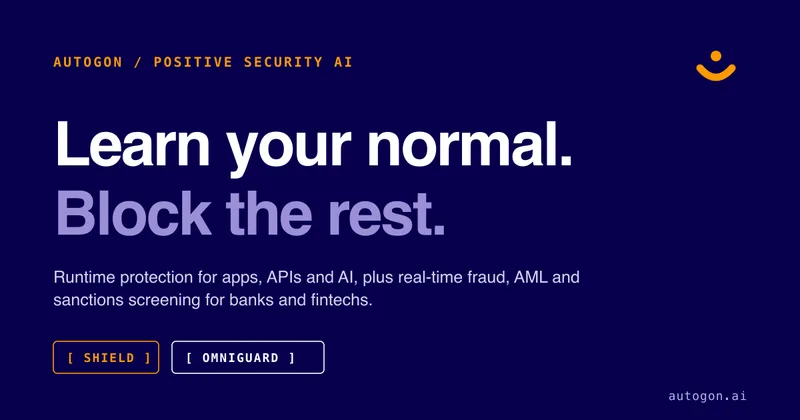
Autogon (Nemesis Labs)
Autogon (Nemesis Labs) provides a suite of security products—Nemesis Shield (runtime & SecOps), Omniguard (fraud, AML & sanctions screening), Nemesis Blue (endpoint/EDR) and Nemesis Red (autonomous pentest)—that learn normal behavior, block deviations, and produce provable evidence for every action. It's aimed at financial institutions, fintechs, enterprises and infra teams.
Adversa AI
Adversa AI provides a coding-agent security platform — a runtime control layer that observes and blocks dangerous actions by AI coding agents, performs continuous adversarial testing, and delivers audit-ready evidence and remediation for enterprises running mission-critical AI.

Livepatrol
Live Patrol provides remote live video monitoring, access control management, remote concierge services and time-lapse video production for commercial and industrial sites, using AI-powered analytics, facial recognition and license-plate recognition to detect, verify and respond to incidents in real time.
Premium Alternatives
Autogon (Nemesis Labs)
Autogon (Nemesis Labs) provides a suite of security products—Nemesis Shield (runtime & SecOps), Omniguard (fraud, AML & sanctions screening), Nemesis Blue (endpoint/EDR) and Nemesis Red (autonomous pentest)—that learn normal behavior, block deviations, and produce provable evidence for every action. It's aimed at financial institutions, fintechs, enterprises and infra teams.