
Rewind.ai
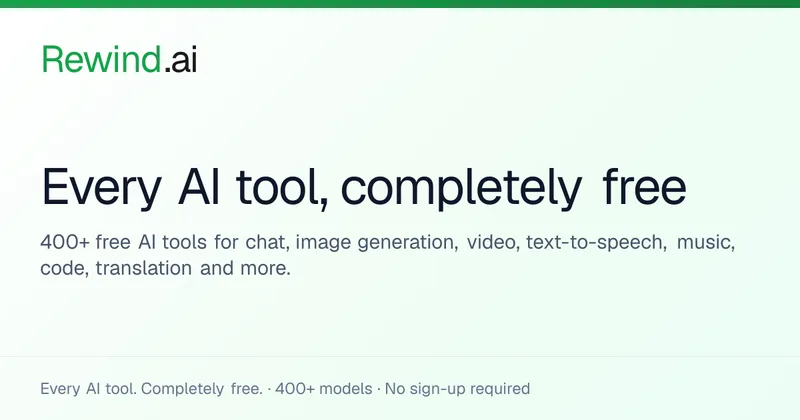
Rewind.ai gives creators and developers browser access to more than 400 AI tools and models for content generation and other tasks. Users can try tools with daily limits or integrate access through a REST API.
One of 74 tools in Coding
Who it's for
- Developers who want to call AI tools through an OpenAI-compatible REST API.
- Creators who need browser-based tools for image, video, voice, music, or writing tasks.
- Teams exploring business-focused AI tools alongside chat, coding, transcription, and translation tools.
Not the right fit if…
- People who need unlimited free usage: the site sets daily tool limits and offers higher allowances through paid plans.
How it fits your workflow
Choose a tool or category in the browser and submit the content or prompt that tool requests. The catalog covers tasks including chat, image and video generation, writing, code, text-to-speech, and transcription.
Use tools without an account within the stated daily limits, or sign up for a free account for more daily usage and saved history. Developers can create an API key and send requests through the OpenAI-compatible REST API.
Pricing
Free: The free plan includes 5,000 tokens per day. The homepage also says tools can be used without signup, with daily limits, and that free account signup increases daily usage.
Free
$0; 5,000 tokens per day
- · Free daily token allowance
- · No credit card required
Basic
$5 per month
- · 200,000 tokens per month
Pro
$19 per month
- · 1 million tokens per month
Business
$49 per month
- · 5 million tokens per month
Prices checked on Oct 2, 2026 from the vendor's site. They can change; confirm before you buy.
Key features
- Catalog of AI tools
- Offers more than 400 tools across categories such as chat, image, video, voice, music, writing, code, design, transcription, translation, and PDF tools.
- Multiple AI models
- Provides access to models for different tasks, including Qwen for chat, FLUX for image generation, Wan for video, Kokoro for text-to-speech, and Whisper for speech-to-text.
- OpenAI-compatible REST API
- Lets developers reach the platform's tools through a REST API, with an API key and examples for cURL, Python, and Node.js shown on the site.
- Customizable homepage
- Signed-in users can reorder tabs, remove tabs, and add tools as top-level tabs; the page says these settings are saved to the account on that browser.
- Browser-based access
- The site says it works in mobile, tablet, and desktop browsers without installing an app.
Limitations to know
- Tool usage is subject to daily limits that reset every 24 hours.
- Anonymous usage is limited; the site lists 20 chat messages, 5 image generations, and 10 writing tasks per day for users who are not signed in.
- The listed paid plans provide fixed monthly token allowances: 200,000 for Basic, 1 million for Pro, and 5 million for Business.
Getting started
- Visit the homepage and choose a tool or category.
- Start using the tool without an account, or sign up for a free account to increase daily usage and save history.
- To use the API, sign up for a free account and generate an API key.
Frequently asked questions
Can I use Rewind.ai without creating an account?
Yes. The site says users can open tools and start without an account. A free account provides more daily usage and saves history.
Can generated results be used commercially?
The site says generated results can be used for personal or commercial work.
Is there an API?
Yes. Developers can access the tools through a REST API. The site says to sign up for a free account to get an API key and points to API documentation at /api/.
Does Rewind.ai work on mobile devices?
The site says it works in a mobile browser on a phone, tablet, or desktop, with no app to install.
What are the daily usage limits?
The site says each tool has a daily limit that resets every 24 hours. Anonymous users receive 20 chat messages, 5 image generations, and 10 writing tasks per day; signing up for free increases those limits.
Does Rewind.ai support multiple languages?
The site says chat responds in any language, text-to-speech covers more than 100 languages, translation handles 200 or more language pairs, and the interface is available in more than 30 languages.