
Specification First Agentic Development Plugin and Prove
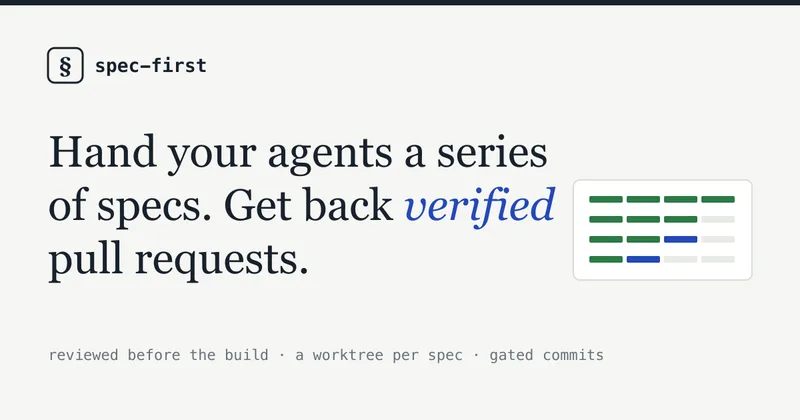
Spec-first guides AI coding agents from a repository-grounded spec through review, implementation, verification, and pull request delivery. Engineering teams use it to make agent-built changes traceable and subject to project checks.
Who it's for
- Software engineers using Claude Code who want feature work to start with a reviewed spec and proceed through a commit gate.
- Engineering teams using Codex, Cursor, or Copilot that want repository instructions and a git hook to apply the same spec-first workflow.
- Teams splitting a larger change into independent specs that they can build in parallel and deliver in one pull request.
How it fits your workflow
Describe the feature in your own words. The agent reads the repository and saved memory, then creates a spec with a goal, cited facts, steps, and done criteria on its own branch and worktree.
A script checks cited evidence, and a fresh reviewer examines the spec against the code. The reviewer can request cuts before the agent builds the approved steps and records non-obvious choices.
The delivery step runs the project's declared verification stages. If they pass, the commit is made, the branch is pushed, and a pull request can be opened. For a series, independent groups can be built in parallel before the merged tree is verified.
Pricing
Free: The method, templates, and Claude Code plugin are free and MIT licensed.
MIT-licensed method, templates, and Claude Code plugin
Free
- · Method and templates are MIT licensed
- · Claude Code plugin is MIT licensed
Prices checked on Oct 28, 2026 from the vendor's site. They can change; confirm before you buy.
Key features
- Specification creation
- The create-spec workflow records a goal, facts with file and line references, implementation steps, and done criteria before code is written.
- Evidence checking and fresh review
- A script checks whether cited files and lines resolve, then a new agent without the original chat context reviews the spec against the code and can request cuts or changes.
- Isolated implementation
- Each spec is built on its own branch and in its own worktree, keeping work separated and supporting parallel specs.
- Build and test commit gate
- The gate runs the verification stages declared in project contexts and blocks a spec commit when a stage fails.
- Decision records and resumable state
- The workflow stores decisions alongside specs and keeps state in context.yaml so work can resume after restarting an agent or machine.
- Series delivery
- The deliver-series workflow groups specs according to dependencies, builds groups that share no files in parallel, verifies the merged tree, and opens one pull request.
Works with
- Claude Code
- Codex, Cursor, and Copilot
- Git and git worktrees
- GitHub CLI
Limitations to know
- The evidence-check script needs PyYAML.
- The git commit-msg hook must be installed in each project clone to run the gate there.
- The page states that `git commit --no-verify` can skip the hook.
Alternatives to consider
-
EasySpecs
Choose it if you want a spec review platform that produces living, code-grounded specifications, validators, and documentation.
-
Railspike
Choose it if you want a file-based framework for guiding coding agents through brainstorming, outlining, planning, and development.
Getting started
/plugin marketplace add holgerleichsenring/specification-first-agentic-development- In Claude Code, add the spec-first marketplace.
- Install the plugin with `/plugin install spec-first@specification-first-agentic-development`.
- Run `/spec-first:bootstrap-project` to create project contexts and rules from the code.
- Use `/spec-first:create-spec`, `/spec-first:review-spec`, `/spec-first:apply-spec`, and `/spec-first:deliver-spec` to move a change through the workflow.
Frequently asked questions
Do I need Claude Code?
No. The Claude Code plugin runs the steps as commands. Codex, Cursor, Copilot, or a terminal can follow the same files through AGENTS.md, and a git commit-msg hook runs the commit gate in clones where it is installed.
What does a spec contain?
The page describes a spec as containing a one-sentence goal, the facts it rests on with file and line references, steps, operator costs of an upgrade, and done criteria. Decisions made while building go into a separate YAML file.
What does it cost?
The method, templates, and Claude Code plugin are free and MIT licensed.
How does it differ from vibe coding?
You still describe the feature in your own words, but the agent then works from a reviewed spec rather than the last prompt, records decisions and their reasons, and only lands a commit when the build and tests pass.