
thumos-care
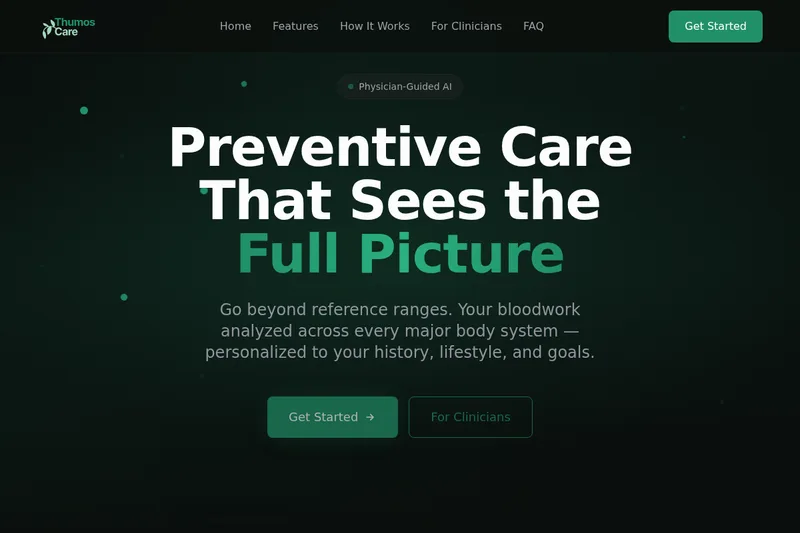
Thumos Care analyzes bloodwork and health records in the context of a person's history and lifestyle, then organizes health insights and recommendations by body system. It also gives clinicians a cited search workflow and tools for managing patient context.
One of 51 tools in Healthcare
Who it's for
- Patients who want to interpret bloodwork alongside medical history, lifestyle, medications, symptoms, and goals.
- Physicians who want to search clinical research and guidelines with citations and optionally include patient data.
- Clinicians managing connected patients who want to add clinical notes that inform patient analyses and health advisor responses.
Not the right fit if…
- People seeking medical advice or a replacement for consultation with a healthcare provider: the site states its content is informational and should not be considered medical advice.
How it fits your workflow
Patients enter health context and upload blood tests, DEXA scans, or other health records as PDFs, Excel files, or manual entries. The platform extracts and organizes results, maps biomarkers across body systems, and cross-references them against a medical knowledge graph.
Users review recommendations, track measurements and changes over time, and ask questions by text or voice using a health advisor informed by their profile. They can invite a physician to view their profile.
Clinicians search PubMed, Cochrane, and named guidelines using natural language or voice dictation. They can attach patient data, review synthesized answers and citations, add notes to patient profiles, and manage patients from a dashboard.
Pricing
Free: The site says users can get started free without a credit card. It does not provide further plan or pricing details in the supplied content.
Free to start
Free to start; no credit card required
- · Upload lab results and view a health analysis
Prices checked on Oct 21, 2026 from the vendor's site. They can change; confirm before you buy.
Key features
- Whole-body biomarker analysis
- Maps biomarkers across major body systems, including cardiovascular, metabolic, hormonal, and immune systems, and shows a status for each.
- Personalized health context
- Uses information such as medical and family history, lifestyle, medications, supplements, symptoms, and goals to put lab results in context.
- Health record upload and extraction
- Accepts blood tests, DEXA scans, and health records as PDFs, Excel files, or manual entries, then extracts and organizes results automatically.
- Trend tracking
- Lets users log changes in lifestyle, medications, supplements, and symptoms, and view trend arrows and historical charts for measurements.
- Profile-aware health advisor
- Provides text or voice conversations grounded in the user's biomarkers, history, medications, lifestyle, and trends.
- Evidence-based clinical search
- Lets clinicians search research and guidelines using natural language or voice dictation, with synthesized answers, inline citations, references, and recommendation grades.
Works with
- PubMed
- Cochrane
- Clinical guidelines
Limitations to know
- The site says its content is for informational purposes and should not be considered medical advice; it advises users to consult a healthcare provider for medical concerns.
Alternatives to consider
-
January AI
Choose it if you need health-data infrastructure with APIs, clinician tools, or a consumer app focused on nutrition and metabolic insights.
-
Medical Chat
Choose it if your main need is a clinician-focused AI assistant for clinical questions, differential diagnoses, and dosing guidance with evidence-grounded citations.
Getting started
- Create a profile with medical history, medications, supplements, lifestyle, symptoms, and goals.
- Upload blood tests, DEXA scans, or health records as PDF or Excel files, or enter results manually.
- Review the body-system analysis and recommendations, then use trend tracking, health advisor chat, or physician collaboration.