
curiosityxr
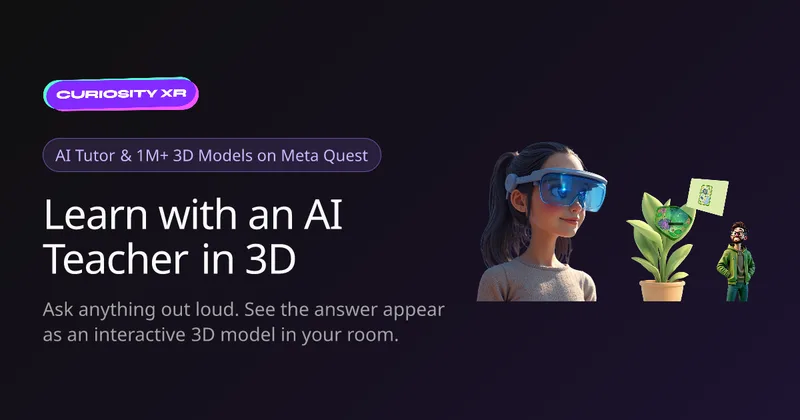
CuriosityXR turns learners' spoken questions into AI-guided lessons with interactive 3D models on Meta Quest and Meta VR glasses. Homeschooling families, teachers, and curious learners can explore subjects in mixed reality.
One of 124 tools in Education
Who it's for
- Homeschooling families who want learner-led, hands-on exploration of subjects such as science and geography.
- Teachers who want to bring interactive 3D models into classroom lessons.
- Curious learners using Meta Quest or Meta VR glasses who want to explore topics through voice and 3D models.
Not the right fit if…
- People without Meta Quest or Meta VR glasses: the page lists these as the supported devices.
How it fits your workflow
Install CuriosityXR from the Meta Horizon Store, then ask a question aloud. The AI teacher responds with a spoken explanation and an interactive 3D model drawn from a library of more than one million models.
Explore the model by grabbing, resizing, or rotating it with hand tracking, controllers, or on-screen controls. On Quest 3 and 3S, models can appear in the real room; Quest 2 and Quest Pro also support a fully immersive VR experience.
Pricing
Meta Horizon Store purchase
One-time purchase; exact price is not stated on the supplied page.
- · No subscription
Prices checked on Oct 20, 2026 from the vendor's site. They can change; confirm before you buy.
Key features
- Voice-based AI tutor
- Learners ask questions aloud and receive a spoken explanation from an AI teacher, with lessons generated from their questions.
- Interactive 3D model library
- The app provides access to more than one million 3D models that learners can inspect, resize, rotate, grab, and explore.
- Mixed reality learning
- On Meta Quest 3 and Quest 3S, models can appear in the user's real room through passthrough; the app also supports a fully immersive VR experience on Quest 2 and Quest Pro.
- Voice, hand, and controller interactions
- Learners can speak questions and interact with models using hand tracking, Meta Quest Touch controllers, or on-screen controls.
- Open-ended subject exploration
- The page lists subjects including anatomy, astronomy, biology, geology, geography, and history, and says there is no fixed curriculum.
Limitations to know
- The supported devices listed are Meta Quest 3, 3S, 2, and Pro, plus Meta VR glasses.
- The page describes a one-time purchase but does not state the price.
Getting started
A supported device: Meta Quest 3, 3S, 2, or Pro, or Meta VR glasses.
- Search for CuriosityXR on a Meta Quest headset or open the store listing from curiosityxr.com.
- Install the app from the Meta Horizon Store as a one-time purchase.
- Ask a question aloud and explore the answer using voice, hand tracking, controllers, or on-screen controls.
Frequently asked questions
What is CuriosityXR?
It is an AI learning app for Meta Quest that puts an AI teacher in the user's room. Spoken questions receive an answer with an interactive 3D model, images, and a spoken explanation.
Which devices does CuriosityXR support?
The page lists Meta Quest 3, 3S, 2, and Pro, plus Meta VR glasses.
How much does CuriosityXR cost and where can I get it?
It is a one-time purchase on the Meta Horizon Store with no subscription. The page says to search for CuriosityXR on a Meta Quest headset or open the store listing from curiosityxr.com; it does not state the purchase amount.
Do you need controllers, or can you use your voice and hands?
The page says learners can speak questions and use hand tracking to grab, scale, and rotate models. Meta Quest Touch controllers and on-screen controls are also available.
Is CuriosityXR an AR app or a VR app?
It is described as a mixed reality app. On Quest 3 and Quest 3S it uses passthrough so models appear in the real room; on Quest 2 and Quest Pro it also works as a fully immersive VR experience.
Is CuriosityXR good for homeschooling?
The page says homeschooling families are among its largest user groups and describes learner-led exploration without quizzes or forced lesson plans.
What subjects can you learn with CuriosityXR?
The page lists anatomy, astronomy, biology, geology, geography, history, and more, with examples including the human heart, solar system, volcanoes, DNA, and world maps.