

HRAG
hRAG is a self-hosted hybrid Retrieval-Augmented Generation (RAG) platform that combines Postgres BM25, vector search, and optional cross-encoder reranking to produce grounded, streamed answers with open citations. It targets teams and operators who want reproducible, benchmarked enterprise document search and the ability to run the full stack locally or on modest cloud infra.
HRAG is recruitment & hr software teams evaluate for recruitment & hr. Use this page to review pricing, integration signals, and the best alternatives before you commit.
Profile facts come from the vendor source. AiMatch labels unknown pricing or API details instead of estimating them.
Review official source →Used in These Packs
Quick Overview
Best for: Recruitment & HR
What it does
Recruitment & HR software for decision-makers comparing workflow fit and alternatives.
Best fit
Recruitment & HR
Pricing snapshot
Paid from €116 per month (reported cost for the entire five-node Hetzner cluster described on the site)
Next step
Compare HRAG with similar tools before you shortlist it.
Compare this tool before you shortlist it
Review alternatives, pricing posture, and workflow fit side by side.
hRAG (hybrid Retrieval with Receipts) is a self-hosted hybrid RAG platform designed for reproducible, grounded answers over large enterprise-style document corpora. It runs retrieval (BM25) and vector search inside Postgres, supports an optional cross-encoder reranker, and streams answers with open citations so each bracketed source opens to the exact backing chunk. The product is aimed at teams and operators who want to run and reproduce benchmarks, keep data isolated via Postgres row-level security, and deploy the stack on modest infrastructure (the authors report a five-node Hetzner cluster at €116/month). The site provides a public 512K-document playground (no login) and instructions plus MIT-licensed repos to build and run the platform yourself.
Self-hosted hybrid RAG on a €116/month cluster — Postgres, BM25, vectors, a reranker, and a public benchmark score for every claim.
Own this listing?
Claim this page for a one-time $29 to add pricing, features, screenshots, verified owner details, and a clearly labeled 30-day category position after the profile is live.
Claim this listing for $29Key Features
BM25 inside Postgres
Uses Postgres text search (pg_textsearch) with real IDF ranking and Block-Max WAND to achieve fast lexical retrieval without maintaining a separate search cluster (88ms over 2M chunks reported).
Hybrid vector + lexical fusion
Combines vector and lexical retrieval with a weightedFusion approach; authors report a 0.3 vector weight produced better results than equal weighting.
Optional cross-encoder reranker
A separate service reads query and chunk together to reorder retrieval windows; reported to improve benchmark score (+3.9) but adds latency (example: ~16 seconds on 2 vCPUs) and ships as an optional checkbox.
Grounded answers and refusal behavior
Empty retrieval results in a refusal without calling the model; on benchmark 'info-not-found' questions the system returns correct refusals where others hallucinate.
Streaming citations
Sources arrive before the first token so every citation bracket in an answer opens to the exact chunk that backs it; streaming of sources is emphasized.
Tenancy via Postgres row-level security
Per-tenant isolation is enforced by Postgres transactions and row-level security so sandbox and benchmark corpora cannot access each other.
Small-model, cost-conscious setup
Advocates for small embedders (118M) and budget answerers to reduce cost; authors publish receipts and per-answer cost claims (tenths of a cent).
Open source & reproducibility
All code MIT; benchmark runs, raw results, and negative results are published in the repo so numbers can be verified.
Pricing
Public 512K-document playground available to everyone with no login; private sandboxes require Google or GitHub sign-in and are limited (10 documents, 20 pages each)
Self-hosted five-node cluster (example)
€116 per month (reported cost for the entire five-node Hetzner cluster described on the site)- Postgres with vectors and BM25
- Four services: ingest, embed, rerank, answer
- Reproducible benchmark score and receipts
Use Cases
Enterprise document search
Search and answer across simulated or real company documents (Slack threads, emails, wikis, tickets) with tenant isolation and grounded citations.
Benchmarking and reproducible evaluation
Run and reproduce EnterpriseRAG-Bench (512K documents) submissions and inspect raw results and receipts to validate retrieval and answer quality.
Self-hosted deployments for cost control
Operators who want predictable, low-cost deployments can run the five-node Hetzner setup or adapt the provided repos to their infrastructure.
Private sandboxing and development
Developers and teams can use private sandboxes (Google/GitHub sign-in) with controlled document and token budgets to test on their own data.
Integrations
Postgres (pg_textsearch + vectors)
Primary storage and retrieval engine for BM25, vectors, text, and tenant row-level security.
Google / GitHub sign-in
Used to create private sandboxes for users who want to test with their own documents.
Hugging Face (leaderboard)
Public leaderboard and benchmark runs are published on Hugging Face (leaderboard referenced on the site).
Benefits
Limitations
Frequently Asked Questions
What am I actually chatting with?
Can I bring my own documents?
How good is it, honestly?
Why should I trust these numbers?
Can I run this myself?
Getting Started
- 1 Visit the public 512K-document playground (no login) to try the live system immediately
- 2 Sign in with Google or GitHub to create a private sandbox (limited to 10 documents, 20 pages each, daily token budget)
- 3 Follow the articles and the MIT-licensed repos which walk through every deployment step and benchmark reproduction to build the platform yourself
Support
docs
Articles on the site walk through deployments and benchmark reproduction step-by-step.
repository
MIT-licensed repos contain the code, benchmarks, raw results, and receipts to build and run the platform.
playground
Public 512K-document playground to test the live system and reproduce benchmark behavior without signing in.
API
Compare HRAG with similar tools
See how it stacks up against alternatives
Related Tools
View all 146 →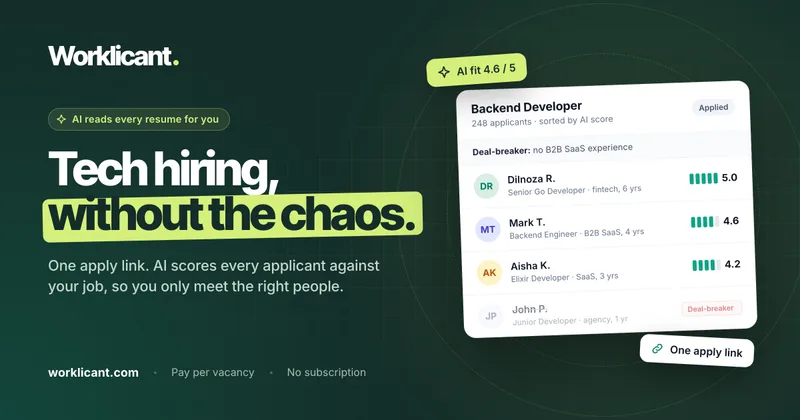
Worklicant
Worklicant is an AI-assisted tech hiring platform for posting vacancies, screening applicants, managing hiring stages, and scheduling interviews. It scores resumes against a job and deal-breaker criteria, with one-time pay-per-vacancy pricing.

OJCP
OJCP (Open Job Context Protocol) is an open standard that defines how AI agents discover, evaluate, and apply to job opportunities via interoperable, privacy-preserving schemas and MCP-native tools, targeted at employers, ATS vendors, job boards, staffing agencies, and agent platforms.
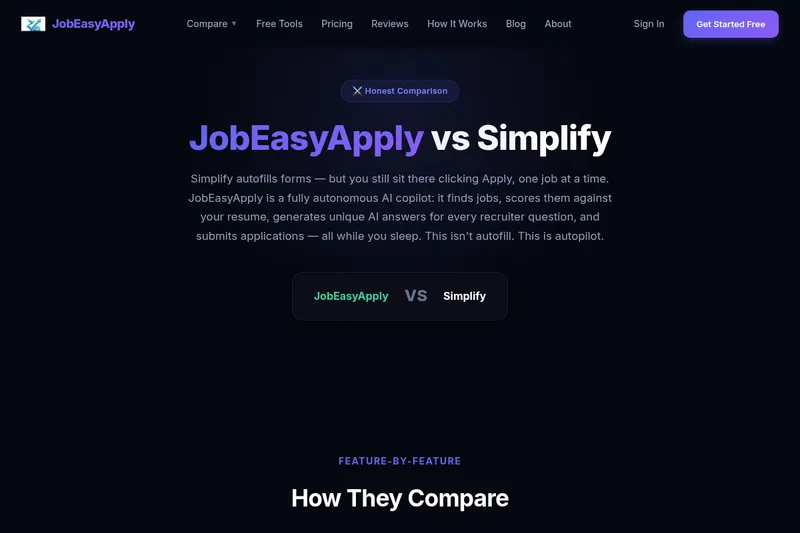
JobEasyApply vs Simplify (2026)
JobEasyApply is a fully autonomous AI job-application copilot that finds LinkedIn Easy Apply jobs, scores them against your resume using vector embeddings, generates unique AI answers to recruiter questions, and submits applications automatically via a Chrome extension.

Resume Worded
Resume Worded is an AI-powered career toolkit that gives instant, tailored feedback on resumes and LinkedIn profiles — offering a resume score based on 30+ recruiter checks, an AI AutoFix that rewrites weak lines, targeted keyword matching for job descriptions, and AI cover letter generation.

Hirelogic
HireLogic is an AI-powered interview intelligence platform that listens to phone, video, or in-person interviews, transcribes conversations, and automatically extracts candidate insights, summaries, compliance flags, and hiring analytics for HR teams and staffing/RPO firms.

talentpair
Talentpair is an AI-assisted hiring platform for companies that want to manage recruiting without hiring a recruiter or using an external agency. It matches and screens candidates, supports interviews, and charges a placement fee only when a company hires a candidate.

resumetrics
ResuMetrics is an AI-powered resume analysis platform that extracts structured data from resumes and automates anonymization/PII redaction via an easy-to-use API, aimed at organizations automating candidate onboarding and resume processing.
Budget-Friendly Alternatives
JobEasyApply vs Simplify (2026)
JobEasyApply is a fully autonomous AI job-application copilot that finds LinkedIn Easy Apply jobs, scores them against your resume using vector embeddings, generates unique AI answers to recruiter questions, and submits applications automatically via a Chrome extension.



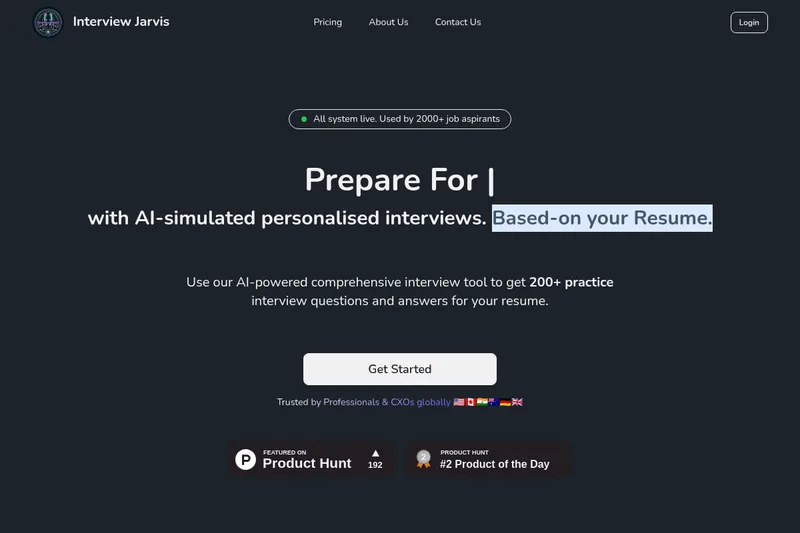
interviewjarvis
Interview Jarvis is an AI-powered interview preparation platform that analyzes your resume to generate personalised interview questions, answers, simulation workflows, role-specific resume analysis, and mock interviews for job aspirants, freshers, and professionals.

Wealthwaggle
Wealth Waggle is an AI-driven career platform that provides resume and LinkedIn optimization, AI chat career coaching, mock interview practice, and personalized career planning to help job seekers, career pivoters, students, and professionals increase interview callbacks and visibility.
Resume Worded
Resume Worded is an AI-powered career toolkit that gives instant, tailored feedback on resumes and LinkedIn profiles — offering a resume score based on 30+ recruiter checks, an AI AutoFix that rewrites weak lines, targeted keyword matching for job descriptions, and AI cover letter generation.

LockedIn AI
LockedIn AI is an AI-powered interview assistant and meeting copilot that listens to live interviews, analyzes questions, and provides real-time answers, coding help, and live coaching. It supports mock interviews, online assessments, a desktop app with editor integrations, and a human-assisted 'Duo' feature.