
kushoai
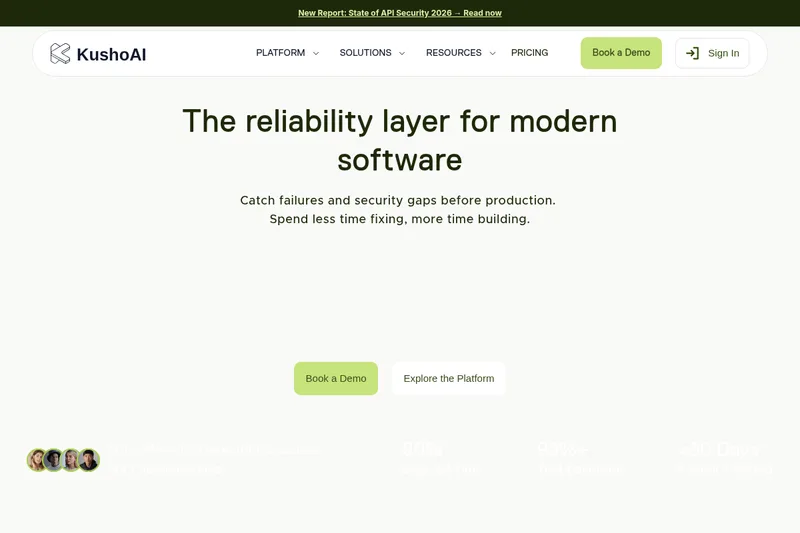
KushoAI generates and maintains software tests, scans APIs for security issues, and validates workflows across an application stack. QA and engineering teams use it to catch problems before production and inform release decisions.
One of 141 tools in Developer Tools
Who it's for
- QA engineers who need API contract tests and end-to-end validation across services, databases, and UI flows.
- Software developers who want tests and security checks to run in their CI pipeline as APIs and code change.
- Engineering managers and leaders who need release risk scores and test-coverage governance to support ship-or-no-go decisions.
How it fits your workflow
Provide an OpenAPI specification or Postman collection to generate API tests. KushoAI checks changes against the contract so breaking changes can be caught before they move forward.
Connect a repository and integrate KushoAI with the CI/CD pipeline. The platform runs tests and security scans as part of the pipeline.
Expand testing from individual APIs to workflows across services, databases, and UI layers. KushoAI detects contract drift, updates impacted tests, and computes release risk scores.
Pricing
Free: A free plan is available with usage and feature limits.
Free plan
$0
- · Free and paid plans are documented. Feature and usage limits depend on the selected plan.
Paid plans
Price not published
- · See the provider pricing page for current rates, billing periods, and usage limits.
Prices checked on Sep 7, 2026 from the vendor's site. They can change; confirm before you buy.
Key features
- API Contract Testing
- Generates test suites automatically from OpenAPI specs or Postman collections and checks changes against API contracts to catch breaking changes before they progress.
- Continuous Security Scanning
- Continuously scans live APIs for vulnerabilities, misconfigurations, and access control risks and runs security testing automatically in CI pipelines.
- Comprehensive Coverage (E2E)
- Validates complete workflows across services, databases, and UI layers so critical user journeys are tested end to end rather than individual endpoints.
- Self‑Healing Testing Infrastructure
- Detects contract drift and automatically updates impacted tests so the test suite stays current as the codebase evolves, reducing manual maintenance.
- Release Intelligence
- Computes an AI risk score for each release based on changes, tests, and past failures to provide a clear signal for release decisions without reading test logs.
- Enterprise Security & Compliance
- Claims SOC 2 and ISO compliance and support for on‑prem deployments, RBAC, and SSO to meet enterprise security requirements.
Works with
- OpenAPI / Postman
- CI/CD pipelines
- Source repositories
- SSO / RBAC
Alternatives to consider
-
QA.tech
Choose it if you want autonomous agents for dynamic regression and exploratory testing across web and mobile applications, rather than KushoAI's emphasis on API contracts, security scanning, and testing across services and databases.
-
Ito
Choose it if you want tests run from source in isolated sandboxes with failure evidence posted to pull requests, rather than KushoAI's API contract testing, security scanning, and release risk scoring.
-
Autify
Choose it if you need AI-driven test generation and maintenance across web, mobile, and desktop applications, rather than KushoAI's stated focus on API contracts, API security, and cross-stack workflows.
Getting started
- Connect your repository.
- Generate initial tests, using an OpenAPI specification or Postman collection for API contract testing.
- Integrate KushoAI with your CI/CD pipeline.
Frequently asked questions
How quickly can we get started with KushoAI?
Most teams start seeing value within the first week. Setup includes connecting your repo, generating initial tests, and integrating with your CI/CD pipeline.
How does KushoAI's AI differ from generic copilots?
Unlike general-purpose LLMs, KushoAI is trained on real testing scenarios, API patterns, and quality engineering workflows; it generates executable tests and orchestrates complex multi-step validations.