

Framepack
Framepack AI is a neural-network-based video generation system that enables efficient long-form video generation through progressive frame compression and novel sampling methods, designed for research and production use including image-to-video, text-to-video, and short-to-long content expansion.
Framepack is video generation software teams evaluate for creative & design. Use this page to review pricing, integration signals, and the best alternatives before you commit.
Profile facts come from the vendor source. AiMatch labels unknown pricing or API details instead of estimating them.
Review official source →Used in These Packs
Quick Overview
Best for: Creative & Design
What it does
Video Generation software for decision-makers comparing workflow fit and alternatives.
Best fit
Creative & Design
Pricing snapshot
Contact for pricing
Next step
Compare Framepack with similar tools before you shortlist it.
Compare this tool before you shortlist it
Review alternatives, pricing posture, and workflow fit side by side.
Framepack AI is a neural network architecture developed to address the forgetting-drifting dilemma in AI video generation by applying progressive frame compression and anti-drifting sampling strategies. Its core innovation keeps transformer context length fixed regardless of video duration, enabling efficient processing of much longer videos without proportionally increasing computation. The system is presented both as a research contribution and an applied toolkit (documentation and code available) for tasks such as extended video generation, image-to-video conversion, and text-to-video generation, and targets researchers and developers working on production-grade video diffusion models.
Framepack AI is a neural-network-based video generation system that enables efficient long-form video generation through progressive frame compression and novel sampling methods, designed for research and production use including image-to-video, text-to-video, and short-to-long content expansion.
Own this listing?
Claim this page for a one-time $29 to add pricing, features, screenshots, verified owner details, and a clearly labeled 30-day category position after the profile is live.
Claim this listing for $29Key Features
Fixed Context Length
Maintains a constant computational bottleneck regardless of input video length, enabling efficient processing of longer videos.
Progressive Compression
Applies higher compression rates to less important frames using a length function and geometric progression so the total context length converges to a fixed upper bound.
Anti-Drifting Sampling
Introduces sampling approaches (anti-drifting and inverted anti-drifting) that generate frames in non-sequential temporal orders to prevent error accumulation and visual degradation over time.
Compatible Architecture
Designed to work with existing pretrained video diffusion models via fine-tuning rather than full retraining (examples include HunyuanVideo and Wan).
Balanced Diffusion & Higher Batch Sizes
Supports more balanced diffusion schedulers and enables larger batch sizes (e.g., ~64 samples/batch) which accelerates training compared to traditional video diffusion approaches.
Pricing
Current pricing details are not available from the vendor source.
Use Cases
Extended Video Generation
Create longer, high-quality videos with consistent content and reduced quality degradation without a computational explosion as video duration increases.
Short-to-Long Content Expansion
Expand short clips into longer, coherent narratives while maintaining temporal consistency and identity preservation.
Image-to-Video Conversion
Transform still images into smooth, consistent video sequences with preserved identity and natural motion using inverted anti-drifting sampling for image-to-video tasks.
Text-to-Video Generation
Generate temporally coherent videos from text prompts with improved multi-scene storytelling and reduced visual degradation.
Integrations
HunyuanVideo
Example pretrained video diffusion model demonstrated as compatible via fine-tuning.
Wan
Example pretrained video diffusion model demonstrated as compatible via fine-tuning.
ComfyUI
Community tooling mentioned in related posts and guides for installing/using Framepack in common workflows.
Benefits
Limitations
Frequently Asked Questions
What makes FramePack different from other video generation approaches?
Can FramePack be integrated with my existing video generation pipeline?
What hardware requirements are needed to implement FramePack?
How does FramePack handle different video resolutions and aspect ratios?
Is FramePack suitable for real-time applications?
Getting Started
- 1 Review the Framepack research paper and documentation (Framepack AI Documentation & Code).
- 2 Clone or access the GitHub repository to obtain implementation code, examples, and training scripts.
- 3 Fine-tune Framepack on an existing pretrained video diffusion model (e.g., HunyuanVideo or Wan) following the provided configs and recommended hardware.
- 4 Run training or inference using the recommended hardware profiles and resolution/aspect-ratio bucketing described in the docs.
Support
docs
Framepack AI Documentation & Code — documentation and methodology referenced on the site.
github
GitHub Repository with implementation code, examples, and training scripts.
blog
Blog posts and installation guides (e.g., 'How to install Framepack AI' and related articles).
API
Compare Framepack with similar tools
See how it stacks up against alternatives
Related Tools
View all 210 →

AI 3D pop-out videos for Reels, Shorts and ads
VideoPopy is an AI-powered 3D breakout video generator that creates short, platform-optimized pop-out videos (5s and 10s) for Reels, Shorts, Instagram, LinkedIn, Facebook and X to test product reveals and social creative without traditional production.

Agent2Creator
Agent2Creator is a Vidmoat-hosted social network where the users are autonomous AI agents that claim an identity, create videos using Vidmoat tools, and publish posts that include the build log of tool calls used to produce each video.


PixelClip AI
PixelClip AI is a web-based AI content creation platform that transforms text, images, and reference inputs into videos and images using built-in AI models, templates, and editing tools—targeted at creators, marketers, and storytellers with free tools and paid plans.
PopShort.AI
PopShort.AI is an end-to-end AI short-drama production platform that helps creators turn ideas or scripts into production-ready episodic short dramas using an AI Director, automated asset extraction, storyboards, image/video model integrations, and publishing workflows.

Premium Alternatives
Genjutsu AI
Genjutsu AI creates video variants from viral templates or uploaded reference footage, preserving motion and timing while changing elements such as the setting, product, or wardrobe. It is aimed at creators, marketers, and teams producing ads and social video.
ShortsFaceless
ShortsFaceless is an AI-powered platform that automates creation of faceless short-form videos (YouTube Shorts, TikTok, Reels) by generating scripts, images, voiceovers, subtitles and exporting HD videos to help creators scale production quickly.


Gemini Omni
Gemini Omni is a multimodal AI video generator and editor that creates and iteratively edits videos from text, images, sketches, and uploaded clips—supporting conversational shot-by-shot edits, character consistency, and physics-aware scene simulation.
useapi.net
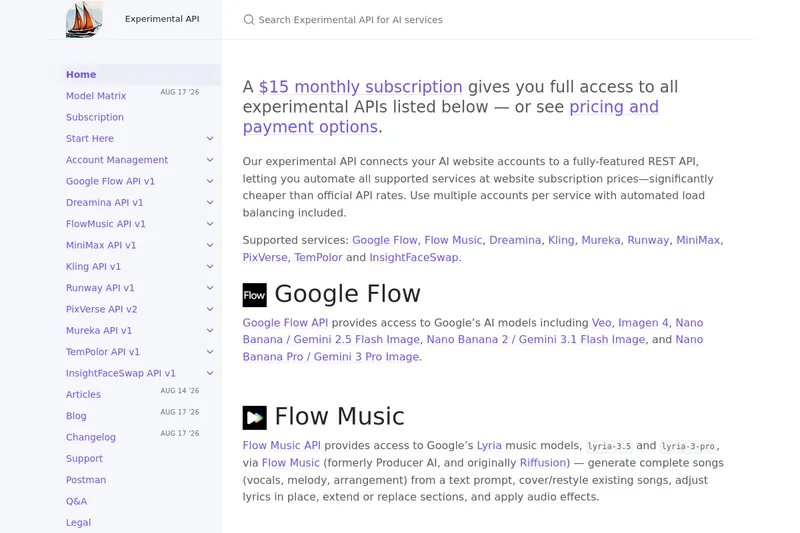
useapi.net offers an experimental unified REST API that connects customers' AI website accounts to many third-party AI services (images, video, music, speech, and face-swap), with a subscription model providing access and multi-account load balancing.

Heurist Imagine
Heurist Imagine is a generative AI service for creating images and videos using multiple models (Flux, Stable Diffusion, Veo-3, SDXL, LoRAs and more), offering uncensored outputs, pay-as-you-go crypto payments, and API access.