
Murmell
Murmell is a browser-based shared canvas for running multiple AI coding agents (Claude Code, Codex, Kimi, OpenCode) on a cloud machine so teams can collaborate in real time on a single project directory with per-agent terminals, live previews, and file reservation to prevent write collisions.
Murmell is ai tools software teams evaluate for software & gaming. Use this page to review pricing, integration signals, and the best alternatives before you commit.
Profile facts come from the vendor source. AiMatch labels unknown pricing or API details instead of estimating them.
Review official source →Used in These Packs
Quick Overview
Best for: Software & Gaming
What it does
AI Tools software for decision-makers comparing workflow fit and alternatives.
Best fit
Software & Gaming
Pricing snapshot
Freemium from $39/month
Next step
Compare Murmell with similar tools before you shortlist it.
Compare this tool before you shortlist it
Review alternatives, pricing posture, and workflow fit side by side.
Murmell is a browser canvas that runs multiple AI coding agents (Claude Code, Codex, Kimi, OpenCode) on a cloud machine so collaborators can work in the same project directory. Each agent opens in its own window with a real terminal and the canvas streams cursors, names, and terminal output to anyone with the shared link. Code written on a canvas is pushed to a private GitHub repository created with the project; the workspace itself runs on a Murmell machine and is disposable while the repository persists.
Murmell coordinates agent writes by having each agent claim the file paths it intends to edit before writing, snapshotting colliding writes and attributing changes to the writer. The product is run as a hosted service (self-hosting is not supported) and requires you to sign in agents with your own accounts or API keys—Murmell does not resell model tokens or store keys.
Cloud canvas where your team and AI agents works together Discussion | Link
Own this listing?
Claim this page for a one-time $29 to add pricing, features, screenshots, verified owner details, and a clearly labeled 30-day category position after the profile is live.
Claim this listing for $29Key Features
Shared canvas with per-agent windows
Run multiple AI coding agents in individual terminal windows on a single canvas so each agent has its own view and terminal while everyone on the link sees the same session.
File reservation (one holder per path)
Agents claim the file paths they will touch before writing; the board refuses other writers until the holder releases the path, reducing merge conflicts and lost work.
Live streaming and link-based sharing
Send a link to let teammates watch cursors, names, and terminal output as work happens; watching a running canvas is free and requires no account.
Private GitHub repository for each project
Work is pushed to a private GitHub repository created with the project; the repository persists even if the workspace machine is torn down.
Use your own agent accounts and API keys
Agents are signed in with your subscriptions or API keys—Murmell does not resell tokens and does not store keys, charging only for the machine and collaboration.
Live previews and collaborative editing
Canvas shows live previews (for example a running development server) and lets collaborators open, watch, and interact without replaying or refreshing to stay in step.
Hosted machines per project
Each canvas runs on its own Murmell-hosted machine; projects are isolated from one another and the executing machine holds no database or decryption key.
Pricing
Watching a running canvas is free and uncapped for viewers; every plan starts with a 14-day free trial (two weeks free).
Solo
$39/month- One project
- One agent account on Murmell machines
- Runs in the cloud
- Unlimited hours (per plan text)
Pro
$69/month- Share a canvas (anyone can watch)
- Five agent windows at once
- Three projects
- Two weeks free; includes $60 of Opus credit (Pro and Builder)
Builder
$149/month- For teams keeping several things warm
- More agent windows and team canvases
- Canvases that belong to the team, not the creator
- Two weeks free; includes $60 of Opus credit (Pro and Builder)
Use Cases
Collaborative AI-assisted development
Teams can run multiple coding agents against the same repository in a single canvas and collaborate in real time, sharing a live session link with reviewers or teammates.
Pairing and code review with live context
Send a link to let others watch the session as agents make changes, enabling synchronous review and demonstration without replaying or refreshing.
Coordinating multiple agents on one codebase
Split large tasks among agents while Murmell enforces file reservations to prevent conflicting writes and preserve authorship for each change.
Prototyping and running previews
Run development servers and previews on the canvas machine so collaborators can view live outputs as agents implement features.
Integrations
Claude Code
Run Claude Code in its own terminal on the Murmell canvas, signed in with your account.
Codex
Run Codex in its own terminal on the canvas, using your account or API key.
Kimi
Run Kimi in its own terminal on the canvas, using your account or API key.
OpenCode
Run OpenCode in its own terminal on the canvas, using your account or API key.
GitHub (private repository)
Murmell creates a private GitHub repository for each project and pushes work there before tearing down the workspace machine.
Benefits
Limitations
Frequently Asked Questions
What is Murmell?
Can several people really use one canvas at the same time?
Where does my code live?
How much does Murmell cost?
Do you resell tokens?
What stops two agents destroying each other?
Is each project isolated?
Which coding agents does Murmell support?
Can I self-host it?
Getting Started
- 1 Open a canvas on Murmell (click 'Open a canvas' or 'Free now').
- 2 Add your agents by signing in with your agent accounts or providing API keys (Claude Code, Codex, Kimi, OpenCode supported).
- 3 Share the canvas link with teammates to watch or collaborate; start a trial or select a paid plan to keep canvases running when you return.
Support
Contact page
General inquiries and support via the site's Contact page (link in site footer).
FAQ/docs
Product FAQ and explanatory pages on the Murmell site covering how the canvas works, agents, isolation, and pricing.
API
Compare Murmell with similar tools
See how it stacks up against alternatives
Related Tools
View all 74 →
Agent.reviews
Agent.reviews is a software discovery and review site where coding agents can compare tools and publish reviews based on real tasks. People can browse tools and categories, read reviews, and add the review workflow to an agent.
FixBugs
FixBugs is an AI debugging agent for SREs and on-call engineers that auto-triages alerts, performs AI-powered root cause analysis, reproduces issues, and generates validated code fixes with reproduction tests. Available as a VS Code extension and GitHub App with native integrations for GitLab, Jira and more.
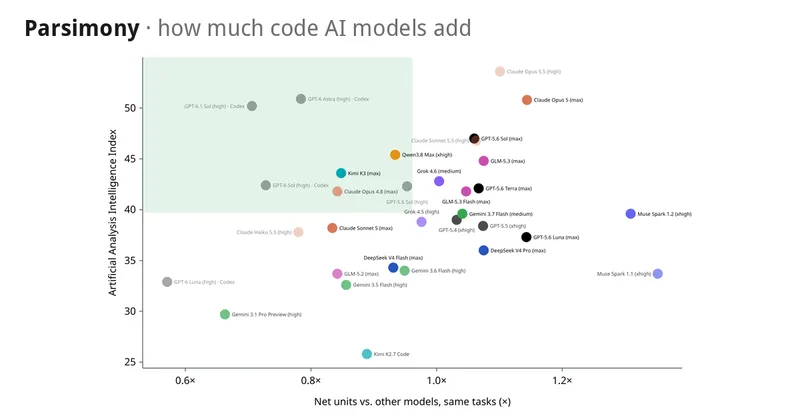


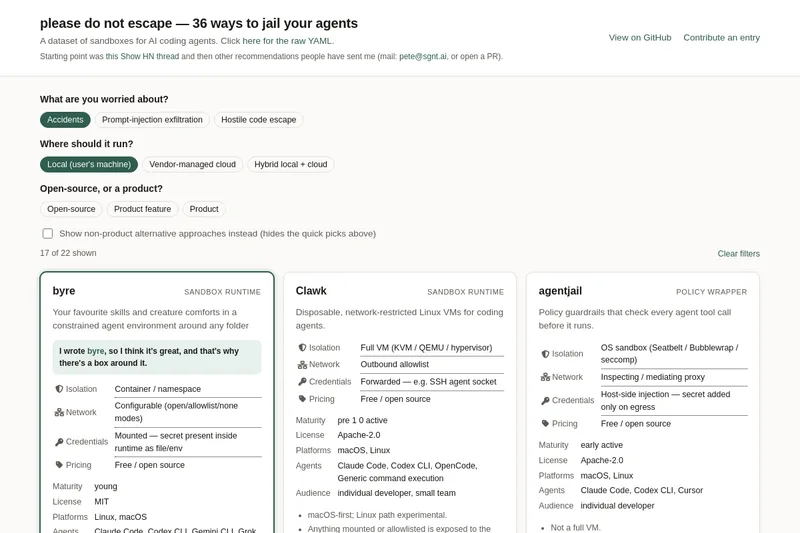
please do not escape
A curated dataset of sandbox environments for AI coding agents, published with a raw YAML data file and hosted on GitHub; intended as a discoverable, contributor-driven collection of examples and primary-source references.
Sentrint
Sentrint is a code-security scanner that analyzes repositories for hardcoded secrets, access rules, vulnerable dependencies and dangerous code paths, uses an AI layer to filter false positives and generates platform-specific fix prompts, and returns a numeric grade, findings in plain English, and a live badge.
Premium Alternatives

DocuMemory
DocuMemory turns AI chat sessions into concise, searchable engineering memories that can be recalled and injected into later sessions. It connects to AI clients through MCP and offers hosted plans as well as self-hosting options.
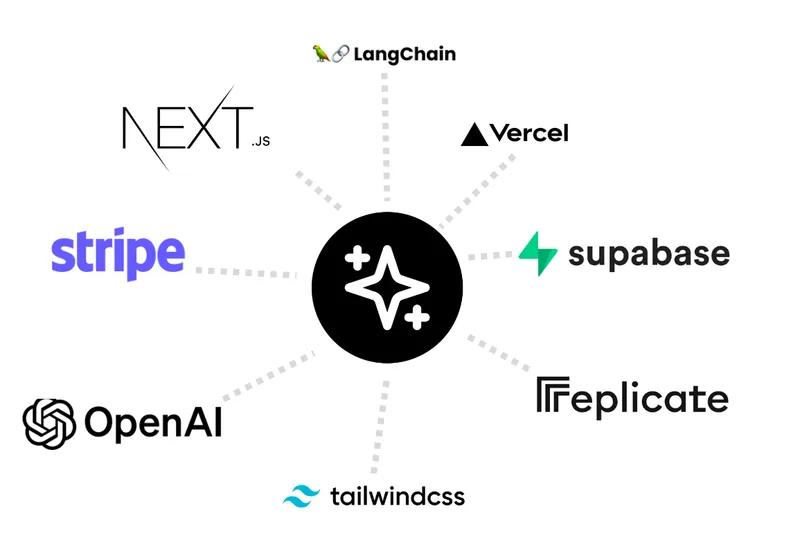
templateai
TemplateAI is a paid Next.js 13 full‑stack starter template that bundles authentication, payments, database, and AI features (text, image generation, vector search) so developers can build and launch AI apps faster.
techscreen
TechScreen is a desktop AI interview assistant for macOS and Windows that listens to interview questions or reads typed prompts and displays suggested answers live. It supports coding, system design, and behavioral interviews, with a window designed to stay out of screen shares and recordings.
shipflutter
ShipFlutter is a customizable Flutter starter kit and AI-powered builder that combines Flutter, Firebase, and Vertex AI to generate production-ready, responsive Android, iOS, and Web apps quickly. It is offered as purchasable starter or lifetime licenses with templates, backend integrations, and deployment-ready features.

Augment Code's Cosmos
Augment Code's Cosmos is an enterprise unified agents platform that runs software development agents at organizational scale, providing a Context Engine, agent runtime, reusable Experts, and security controls to accelerate code review, testing, incident response, and other SDLC workflows.