
Starwell
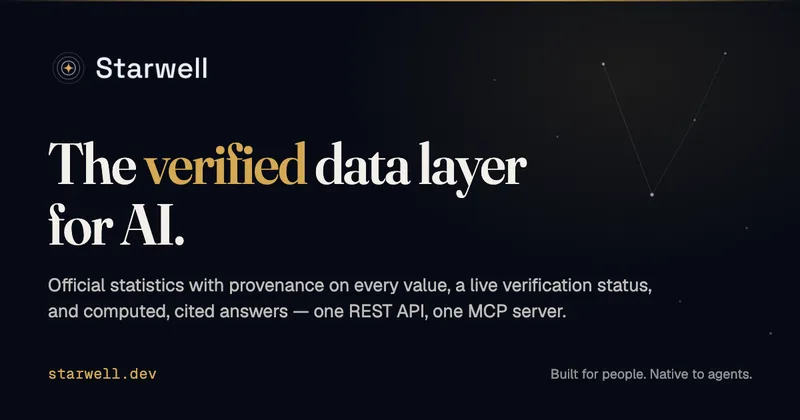
Starwell is a verified data layer for AI that harmonizes official statistics into a single REST API and MCP server, returning values with provenance, citations, and license information to prevent numerical hallucinations by agents.
Starwell is research software teams evaluate for research. Use this page to review pricing, integration signals, and the best alternatives before you commit.
Profile facts come from the vendor source. AiMatch labels unknown pricing or API details instead of estimating them.
Review official source →Used in These Packs
Quick Overview
Best for: Research
What it does
Research software for decision-makers comparing workflow fit and alternatives.
Best fit
Research
Pricing snapshot
Free from Free (no card required)
Next step
Compare Starwell with similar tools before you shortlist it.
Compare this tool before you shortlist it
Review alternatives, pricing posture, and workflow fit side by side.
Starwell provides a verified data layer designed for AI and agents by ingesting official statistical releases from public institutions, normalizing them, verifying values against source agencies, and serving every value with provenance, citation, and license information. The product exposes a versioned REST API (v1) and an MCP server so clients and agents can query observations, computed answers, and related metadata programmatically. Starwell targets developers, AI agents, and data consumers who need authoritative, machine-readable official statistics to prevent hallucinated numbers and ensure each returned value cites its official source.
Verified official statistics for people and AI agents: one REST API, one MCP server. Every value served with provenance, a verification status, and a citation to the official source. Free with an account.
Own this listing?
Claim this page for a one-time $29 to add pricing, features, screenshots, verified owner details, and a clearly labeled 30-day category position after the profile is live.
Claim this listing for $29Key Features
Versioned REST API (v1)
Endpoints for sources, datasets, series, observations, and computed answers; example usage shown and OpenAPI 3.1 available at /openapi.json.
MCP server
An MCP (Streamable HTTP) server exposing tools such as catalog search, fetching observations, computing answers, and managing monitors; machine-readable server config provided.
Computed answers with citations
Ask in plain English and receive computed, cross-source answers that cite the data points and include provenance and license metadata.
Provenance and license on every value
Every returned value includes provenance metadata (source URL, retrieval time, connector version), a citation block, and license information indicating redistributability and training eligibility where applicable.
CSV export
Observations endpoints support format=csv; CSV exports include citation and license as header comments.
Embeddable SVG charts
Each indicator can be rendered as an embeddable SVG chart available at chart.svg, requiring no JavaScript.
Webhook monitors & changelog feed
series.updated webhooks notify user URLs when new or revised values land; a machine-readable changelog is available at /changelog and /changelog.xml (Atom).
Catalog of official sources
Indexed official sources (29 listed on the site) including World Bank, Eurostat, ILOSTAT, Statistics Canada, BEA, Australian Bureau of Statistics, etc., with counts of datasets and data points.
Pricing
Free tier available; no credit card required and agents/computed answers are supported on the free plan.
Free
Free (no card required)- Access to the catalog and API on the free tier
- Agents and computed answers available on the free plan ("Join agencies in one question, on every plan including free")
Use Cases
AI agents that need verifiable numbers
Agents can POST /v1/answer to obtain computed, cited answers to natural-language questions, reducing hallucinated numeric claims.
Cross-source economic analysis
Compute and compare indicators (e.g., inflation across multiple economies) with each returned value citing its official source and reference period.
Programmatic access to official statistics
Developers and analysts can fetch series and observations via the REST API or MCP server and export data as CSV with accompanying citation and license headers.
Monitoring official releases
Use webhook monitors (series.updated) to trigger workflows when agencies publish new or revised values.
Embeddable charts for publications
Embed SVG charts for indicators directly into websites without JavaScript, preserving citation and provenance context.
Integrations
World Bank Open Data (World Development Indicators)
Ingested as an official source; site lists 29,490 datasets and 26,200,020 data points from World Bank.
Eurostat (EU statistics dissemination API)
Ingested Eurostat datasets (6,753 datasets and 6,169,981,591 data points listed).
ILOSTAT (International Labour Organization)
Integrated ILOSTAT data (1,958 datasets and 423,758,441 data points listed).
Statistics Canada
Integrated Government of Canada data (8,269 datasets and 35,250,530,993 data points listed).
U.S. Bureau of Economic Analysis (BEA)
Included as an official source (607 datasets listed).
Australian Bureau of Statistics
Included as an official source (1,227 datasets listed).
Federal Reserve Economic Data (FRED)
Example responses show FRED series and provenance metadata pulled from the FRED API.
Benefits
Limitations
No verified limitations are available.
Frequently Asked Questions
No verified FAQs are available.
Getting Started
- 1 Create a free account and get your free key (free tier, no card required).
- 2 Explore the catalog to find sources, datasets, series and sample queries.
- 3 Use the REST API (v1) or point a client to the MCP server (https://starwell.dev/api/starwell/mcp) and consult /openapi.json for API details.
Support
docs
Documentation and API spec available on the site (Docs link, OpenAPI 3.1 at /openapi.json).
Contact via [email protected]
API
/openapi.json (OpenAPI 3.1) and site REST endpoints under /api/starwell/v1
Compare Starwell with similar tools
See how it stacks up against alternatives
Related Tools
View all 143 →
ThoughtDAG
ThoughtDAG is an open-source, desktop-first application that makes LLM context visible, editable, and reproducible by representing context as an editable directed acyclic graph (wires = context) and letting users preview and control exactly what the model receives.

LLM Attention Visualization
A browser-based interactive visualization that shows how transformer LLMs allocate attention to past tokens during generation by aggregating attention weights and value magnitudes across heads and layers.

PilotCite
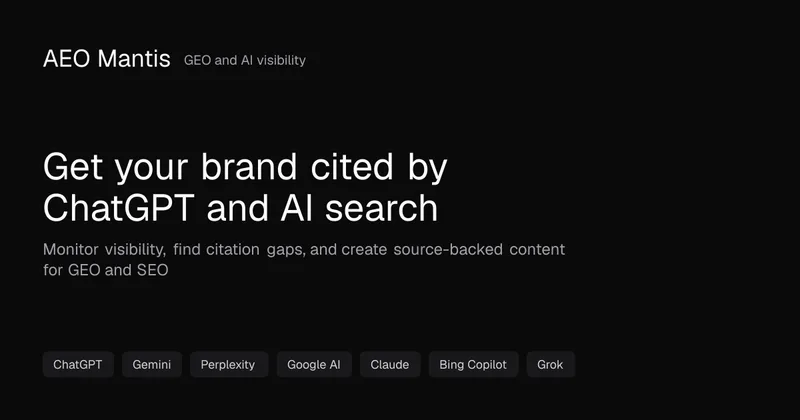
PilotCite is a SaaS platform that helps brands monitor and improve their visibility in AI-generated answers (ChatGPT, Perplexity, Google AI, Gemini, Claude, Copilot, Grok) by tracking citations, auditing site citability, benchmarking competitors, and generating source-backed content.
Redactle LLM Leaderboard
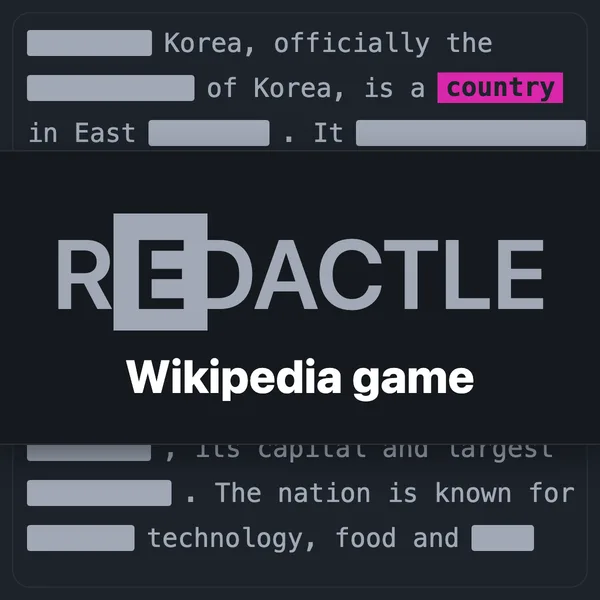
A public benchmark dashboard that evaluates how well large language models (LLMs) solve Redactle puzzles by running standardized evaluations and publishing ranked results, costs, and performance metrics.

Knowledge graph skill for Claude/Kimi Code
SysEdge is an ontological knowledge graph and CLI for multi-agent Claude Code and Kimi Code teams that models requirements, tests, and architecture standards to surface specification, test, and standards gaps before code ships and to reduce agent orientation tokens.

HieraticBench
HieraticBench is an open benchmark for testing whether AI models can identify and read hieratic, the cursive handwriting of ancient Egypt. It includes a public leaderboard, evaluation harness, and dataset of documents and individual signs.
Premium Alternatives

CiteRank
CiteRank is a weekly SaaS monitoring tool that re-asks buyer questions of major AI answer engines (ChatGPT, Perplexity, Google AI Overviews, Gemini and Claude) to record whether they cite your site, name your brand, or leave you absent, and delivers board-style reports and competitor/source lists.


grantboost
Grantboost is an AI grant discovery and proposal-writing platform for nonprofits, agencies, universities, and other mission-driven organizations. It matches funding opportunities to an organization’s programs and helps draft proposals using its past content and brand voice.
OutlierKit
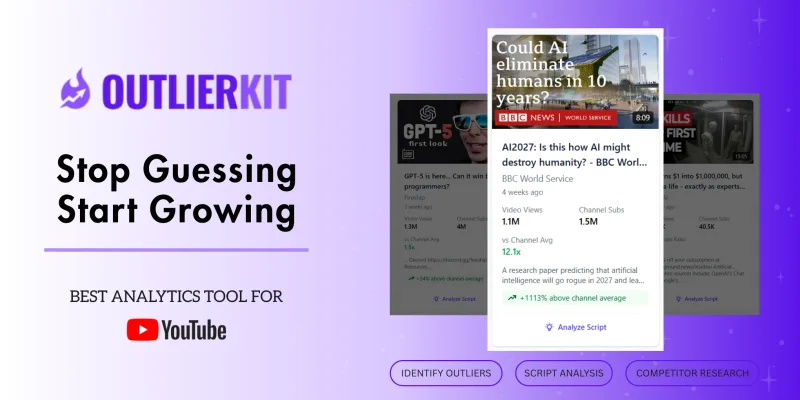
OutlierKit is a YouTube competitor analysis and outlier research platform that maps niche-wide opportunities from a single seed channel, surfaces overperforming videos, analyzes audience psychology, sponsors, and monetization, and offers AI-powered script/hook analysis and integrations for creators, teams, and agencies.



AI ChatDocs
AI ChatDocs is a GPT-4 powered document chat and summarization tool that lets users upload PDFs, Word/PPT/Docx/TXT files, websites, sitemaps and YouTube videos to generate summaries, extract references, and interactively chat with document content.

SermonAI
SermonAI is a web-based sermon preparation platform for pastors, combining AI-assisted research and writing with planning, sermon organization, preaching tools, and content repurposing. Its AI research can be tailored to a pastor’s denomination, Bible translation, and trusted voices.