
Aclif
aclif is an Agent CLI Framework that builds command-line tools for AI agents, providing a unified command grammar and canonical names across multiple SaaS providers to let agents discover, introspect, and run provider operations with consistent safety and auditing.
Aclif is ai agents software teams evaluate for ai agents. Use this page to review pricing, integration signals, and the best alternatives before you commit.
Profile facts come from the vendor source. AiMatch labels unknown pricing or API details instead of estimating them.
Review official source →Used in These Packs
Quick Overview
Best for: AI Agents
What it does
AI Agents software for decision-makers comparing workflow fit and alternatives.
Best fit
AI Agents
Pricing snapshot
Pricing available on request
Next step
Compare Aclif with similar tools before you shortlist it.
Compare this tool before you shortlist it
Review alternatives, pricing posture, and workflow fit side by side.
aclif is an Agent CLI Framework that provides a single, unified abstraction for AI agents to interact with multiple SaaS providers. It presents one grammar, one command structure (JSON envelope), and one error vocabulary across providers so an agent can discover, learn, introspect, preview, and execute provider operations without loading every provider definition into context. The project targets agent integrations, host applications, and enterprise gateway deployments where credentials, policy, and audit are centrally managed.
aclif is a framework for building command-line tools that AI agents use to reach SaaS platforms: one grammar, self-describing commands, declared safety metadata, and a runtime that runs the same commands from a shell, in a tool call, or behind a gateway.
Own this listing?
Claim this page for a one-time $29 to add pricing, features, screenshots, verified owner details, and a clearly labeled 30-day category position after the profile is live.
Claim this listing for $29Key Features
Unified grammar and envelope
One command structure, one JSON envelope, and one error vocabulary across every provider so agents learn the tool once and commands behave consistently.
Canonical names and tenant catalogs
Alias sets and tenant catalogs map provider-specific object and field names (for example mapping a customer to Account in Salesforce and core_company in ServiceNow) so records are reachable by canonical names across instances.
Introspection-first workflow
Flags such as --schema, --examples, --shape and others return before execution, require no credentials, and count against no API quota so agents can discover and preview commands without spending API calls.
Embeddable runtime
Command classes run in-process inside a host that supplies credentials, identity, and policy per request; hosts can keep connections warm and cache expensive logins per instance.
Declared safety metadata
Every command declares mutability, blast radius, reversibility, and idempotency; commands may require --confirm, accept --dry-run, and write audit lines after runs.
Multiple run topologies
The same command classes run by an agent process, by a host application (design-time), or behind a long-lived gateway (runtime) with different credential and audit models.
Provider support and scaffold
Built-in providers ship with the binary and a scaffold command can produce a CLI with a chosen name, config directory, environment variables, and selected providers.
Pricing
Current pricing details are not available from the vendor source.
Use Cases
Agents spanning multiple platforms
Let an AI agent access many SaaS providers with one consistent grammar and canonical names so the agent's context size remains small regardless of provider coverage.
Design-time validation and embedding
Host applications can let a model discover providers, introspect commands, and validate exact commands at design time without giving the model provider credentials.
Enterprise gateway deployments
Run aclif behind a gateway that resolves credentials per request from a vault, enforces policy, records audit events, and provides enterprise-wide canonical names and catalogs.
Interactive CLI use
Install the aclif binary for interactive use: discover providers, read schemas and examples, and run queries or commands directly from a terminal.
Integrations
Salesforce
Native provider included in every release; examples and authentication flows (instance URL and access token or security token) are shown.
ServiceNow
Native provider included in every release and accessible via aclif commands (e.g., data query --table incident).
DocuSign
Native provider included in every release.
Agentforce
Native provider included in every release.
Google Workspace (Gmail, Calendar)
Contributed provider (community-contributed) available.
Private tier providers
A private tier holds providers a fork keeps to itself under a path upstream never commits to.
Benefits
Limitations
Frequently Asked Questions
No verified FAQs are available.
Getting Started
- 1 Install the binary: npm install -g @aclif/core and ensure Node 22 or later.
- 2 Discover available providers: aclif discover --json and learn a provider: aclif learn salesforce --json.
- 3 Read a command's schema and examples: aclif salesforce data query --schema and --examples.
- 4 Run queries or commands with --dry-run to preview, then run with --json for machine-readable output.
- 5 For provider access, set required environment variables or tokens (examples shown for Salesforce) before running commands.
Support
docs
In-site documentation pages referenced: Getting started, Build a CLI, Embedding, Providers, and CONTRACT.md.
github
Repository and contribution guides referenced (CONTRIBUTING.md, AGENTS.md) and example workflow with contributions; GitHub link is referenced on the site.
API
CONTRACT.md and JSON Schemas are referenced on the site as the contract for commands.
Compare Aclif with similar tools
See how it stacks up against alternatives
Related Tools
View all 608 →
Needle2
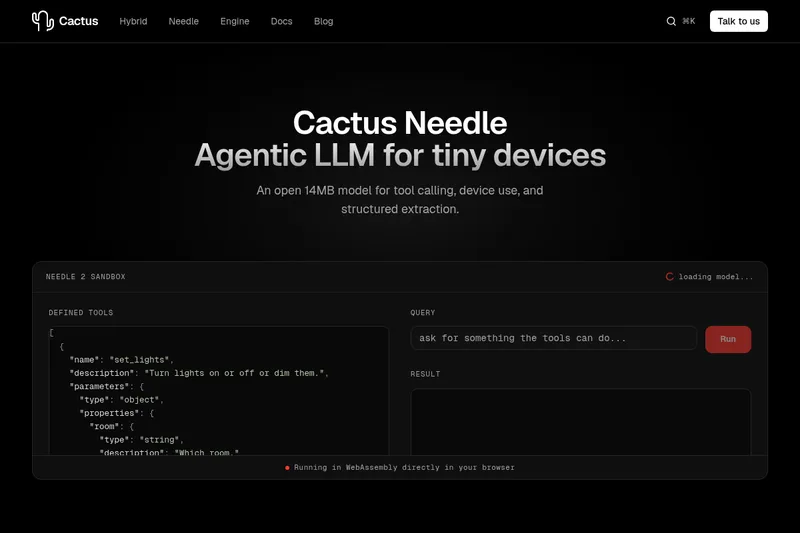
Needle 2 is an open, production-ready 45M-parameter agentic LLM from Cactus designed for tool calling, device control, and structured extraction on extremely small devices; the shipped CQ2-bit binary is ~14 MB and runs in ~28 MB of RAM across Cortex-M, microcontrollers, phones, Raspberry Pi and WebAssembly.
The cheapest GPU cloud
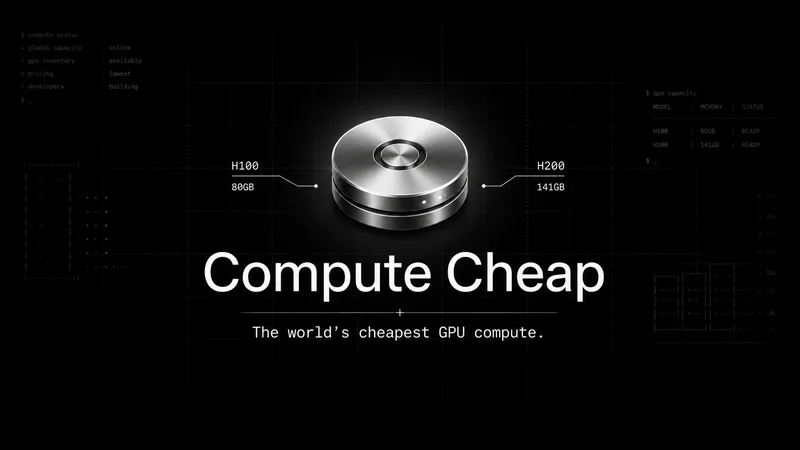
Compute Cheap provides low-cost GPU compute for training and inference, offering H100 and H200 SXM GPUs as interruptible or reserved capacity with published per-GPU-hour pricing and a simple request/reserve/run workflow.
Oodle.ai
Oodle Agent Observability provides agent/LLM observability at scale with S3-backed columnar storage, fast search (<1s P99), out-of-the-box AI-powered insights, and flat ingestion-based pricing designed to retain 100% of traces affordably for debugging and optimizing production agents.



AgentDrive
AgentDrive is a cloud filesystem by Token Canopy that provides durable, shared drives for AI agents and human teammates to store and share files and context across work sessions, with an API intended for direct agent use.
Premium Alternatives
Abliterated LLM provider for cyber tasks
Refuseless hosts GLM 5.3 Abliterated models through an OpenAI-compatible API for cybersecurity and coding work. The page states that prompts are not retained and shows integrations with OpenCode and Pi.
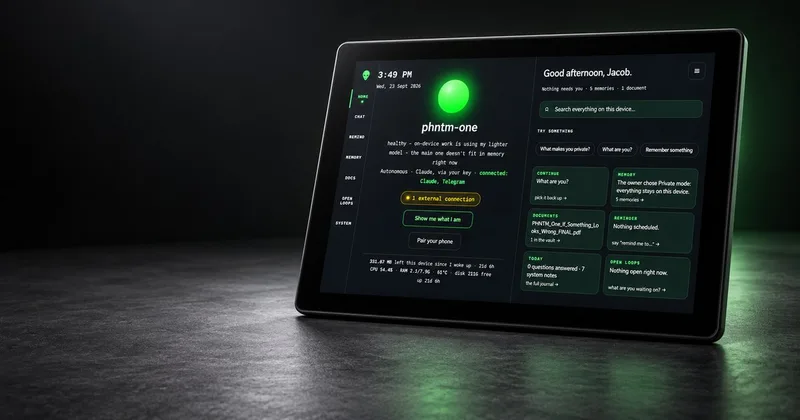
PHNTM ONE
PHNTM One is a private, local-first AI appliance: a hand-built desktop device (Raspberry Pi 5, 8 GB, 10.1″ touchscreen) that runs an on-device model (Gemma 3 4B) to provide a voice-capable assistant, memories, document reading, timers, Home Assistant integration and offline knowledge — sold as a one-time $549 purchase with no subscription and zero telemetry by default.
AletheionAGI
AletheionAGI provides a grounded-memory layer for AI systems that enforces evidence-bound delivery, namespace isolation, and policy authorization so AI readers cannot produce unsupported claims. It's targeted at production-facing use cases like customer support, commerce agents and internal copilots.

ClaudeThings
ClaudeThings provides a packaged, continuously-updating set of 89 specialized agents, 103 pre-built skills, and 181 slash commands that act as an AI engineering and marketing team for Claude Code — delivered as a private GitHub repo and installed with a single npx command. It adapts to any stack via a CLAUDE.md project manifest and is sold as a one-time purchase with lifetime updates.
AI Collective
AI Collective is a SaaS platform from Teknikforce that aggregates 50+ AI models (text and image) into a single multi-AI interface for content generation, image creation, coding, document Q&A and more, marketed to businesses and creators as a cost-saving alternative to multiple subscriptions.