

Sentinel
Sentinel is an open-source (MIT) autonomous QA agent that reads a codebase to derive end-to-end business flows and tests them across frontend and backend, combining deterministic repo recon, model-driven planning, Playwright browser automation, and backend assertions.
Sentinel is ai agents software teams evaluate for software & gaming. Use this page to review pricing, integration signals, and the best alternatives before you commit.
Profile facts come from the vendor source. AiMatch labels unknown pricing or API details instead of estimating them.
Review official source →Used in These Packs
Quick Overview
Best for: Software & Gaming
What it does
AI Agents software for decision-makers comparing workflow fit and alternatives.
Best fit
Software & Gaming
Pricing snapshot
Contact for pricing
Next step
Compare Sentinel with similar tools before you shortlist it.
Compare this tool before you shortlist it
Review alternatives, pricing posture, and workflow fit side by side.
Sentinel is an open-source MIT-licensed QA agent that reads your repository to derive prioritized end-to-end business flows and then executes those flows against both the frontend and backend to validate persistence and behavior. It combines a deterministic recon pass over common JS stacks (Next.js routes, Express/Fastify, Prisma/Drizzle/SQL schemas) with a model (Mimo by default) that plans flows, Playwright-driven browser automation, and a first-class API request tool to check server state. Sentinel is intended for engineering and QA teams who want scheduled, commit-driven automated end-to-end testing and design checks without hand-writing flow plans.
Sentinel is an open-source AI QA agent that reads your repo, derives the real business flows, and tests them end to end across the frontend and the backend.
Own this listing?
Claim this page for a one-time $29 to add pricing, features, screenshots, verified owner details, and a clearly labeled 30-day category position after the profile is live.
Claim this listing for $29Key Features
Repo recon (deterministic)
A recon pass that parses the repo (grep/find style, no model calls) to extract frontend routes, API modules, services, and database entities so the model reasons over a digest rather than crawling blindly.
Model-driven flow derivation
A reasoning model (Mimo by default) converts the repo digest into a prioritized list of end-to-end business flows, each with UI steps, backend assertions, and edge cases; plans are cached per commit.
Automated flow execution
An agent loop where the model decides actions, Playwright drives the browser, and an api_request tool fetches server state (replaying the Authorization header the frontend sent) to assert persistence and backend behavior.
Vision/design pass
A multimodal vision pass grades each distinct screen visited (deduped by URL) for visual hierarchy, spacing, likely WCAG contrast issues, typography problems and broken states using a multimodal model.
Web3 wallet support (injected burner)
For wallet-gated apps Sentinel injects a Node-backed window.ethereum provider with an unfunded burner key (reads allowed, broadcasts blocked) so the agent can connect and test without using a real wallet or sending transactions.
Scheduler and CI-friendly
Runs on a schedule (example: launchd tick every 15 minutes), can review every commit, and supports configurable cadences and knobs (flows per run, attempts per flow, steps per attempt).
Lightweight, auditable stack
Deliberately small operational footprint (bash, Node, TypeScript, launchd scheduler) with no hosted service or database; every run leaves evidence on disk (screenshots, structured report, vision findings).
Open-source CLI
A local CLI with doctor checks and example targets; install and run steps are provided in the repository README and blog post.
Pricing
Sentinel is open-source under the MIT license (no hosted pricing listed on the announcement); model and compute costs are user-managed and mentioned only as per-run examples in the post.
Use Cases
End-to-end QA for full-stack apps
Automatically derive and validate critical business flows across frontend and backend (e.g., reservation lifecycle, check-in/check-out, payments) without hand-written test plans.
Continuous QA on commit or schedule
Run flows on every new commit or on a cadence to catch regressions and integration bugs early across many repositories.
Design and accessibility review
Automated visual checks on visited screens to detect layout issues, contrast/typography problems, and broken visual states beyond DOM-only checks.
Web3 wallet-dApp testing
Test wallet-gated flows by injecting a controlled, unfunded burner provider to exercise connect, signing, and UI behaviors without broadcasting transactions.
Cross-layer bug detection
Find bugs that only appear when checking both UI and API/backend state (e.g., state-machine mismatches, API returning NO_AVAILABILITY despite reserved room).
Integrations
Playwright
Drives the browser for UI actions and recordings during flow execution (used as the browser automation tool).
Mimo / Xiaomi models (default)
Default decision model used to derive and drive flows; configurable via QA_PROVIDER/QA_MODEL environment variables.
OpenAI-compatible endpoints / OpenRouter / local models
Vision and model endpoints can be pointed at OpenAI-compatible APIs, OpenRouter, or local models via environment variables (VISION_* and provider knobs).
pi CLI / pi agent harness
Requires the pi CLI with a provider configured; Playwright-backed browser tools are registered as a pi extension in the agent harness.
Common JS stacks (Next.js, Express, Fastify, Prisma, Drizzle, SQL)
Recon pass is designed to digest repositories using these frameworks and schemas so flows can be derived for typical full-stack JS apps.
Benefits
Limitations
Frequently Asked Questions
No verified FAQs are available.
Getting Started
- 1 Clone the repository: git clone https://github.com/Simbastack-hq/sentinel.git && cd sentinel
- 2 Install dependencies and the QA browser extension: npm install && ( cd pi-ext/qa-browser && npm install )
- 3 Copy example config files and configure provider: cp config/sentinel.env.example config/sentinel.env && cp config/targets.json.example config/targets.json, ensure the pi CLI and a model provider are configured, then run bin/sentinel doctor && bin/sentinel run <your-app> qa
Support
Docs
Repository includes examples/ and config templates; run bin/sentinel doctor to check environment and prerequisites (mentioned in the blog post).
GitHub issues/PRs
Project is on GitHub and the post invites PRs and issues: github.com/Simbastack-hq/sentinel
API
Compare Sentinel with similar tools
See how it stacks up against alternatives
Related Tools
View all 608 →
Needle2
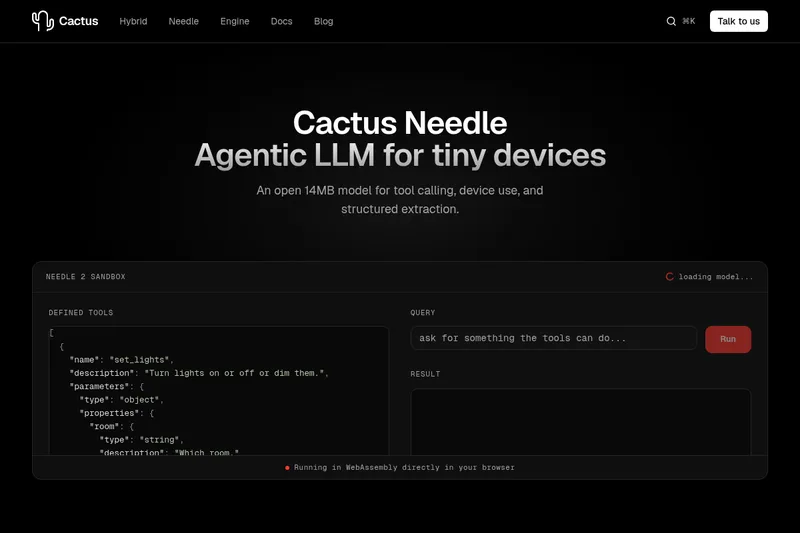
Needle 2 is an open, production-ready 45M-parameter agentic LLM from Cactus designed for tool calling, device control, and structured extraction on extremely small devices; the shipped CQ2-bit binary is ~14 MB and runs in ~28 MB of RAM across Cortex-M, microcontrollers, phones, Raspberry Pi and WebAssembly.


The cheapest GPU cloud
Compute Cheap provides low-cost GPU compute for training and inference, offering H100 and H200 SXM GPUs as interruptible or reserved capacity with published per-GPU-hour pricing and a simple request/reserve/run workflow.
Oodle.ai
Oodle Agent Observability provides agent/LLM observability at scale with S3-backed columnar storage, fast search (<1s P99), out-of-the-box AI-powered insights, and flat ingestion-based pricing designed to retain 100% of traces affordably for debugging and optimizing production agents.


AgentDrive
AgentDrive is a cloud filesystem by Token Canopy that provides durable, shared drives for AI agents and human teammates to store and share files and context across work sessions, with an API intended for direct agent use.
Premium Alternatives
Abliterated LLM provider for cyber tasks
Refuseless hosts GLM 5.3 Abliterated models through an OpenAI-compatible API for cybersecurity and coding work. The page states that prompts are not retained and shows integrations with OpenCode and Pi.
PHNTM ONE
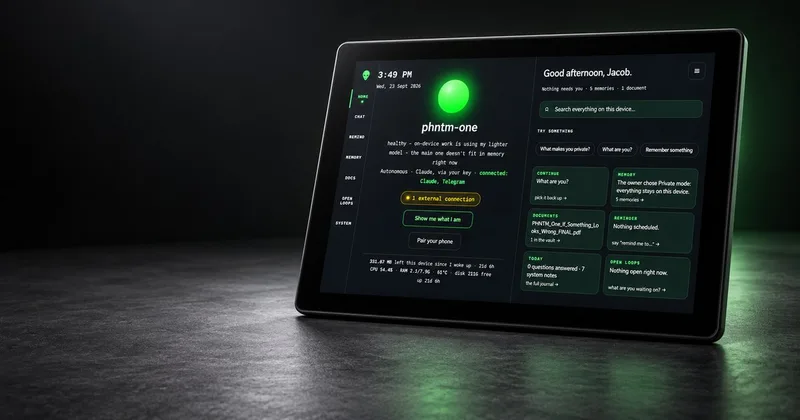
PHNTM One is a private, local-first AI appliance: a hand-built desktop device (Raspberry Pi 5, 8 GB, 10.1″ touchscreen) that runs an on-device model (Gemma 3 4B) to provide a voice-capable assistant, memories, document reading, timers, Home Assistant integration and offline knowledge — sold as a one-time $549 purchase with no subscription and zero telemetry by default.

AletheionAGI
AletheionAGI provides a grounded-memory layer for AI systems that enforces evidence-bound delivery, namespace isolation, and policy authorization so AI readers cannot produce unsupported claims. It's targeted at production-facing use cases like customer support, commerce agents and internal copilots.
ClaudeThings
ClaudeThings provides a packaged, continuously-updating set of 89 specialized agents, 103 pre-built skills, and 181 slash commands that act as an AI engineering and marketing team for Claude Code — delivered as a private GitHub repo and installed with a single npx command. It adapts to any stack via a CLAUDE.md project manifest and is sold as a one-time purchase with lifetime updates.


qomplement
qomplement is an Agentic AI-driven ERP built for supply chain and operations teams that automates tasks across procurement, inventory, freight, finance, and planning to reduce manual work and scale operations without adding headcount.