

agno
Agno provides AgentOS, a production-grade agent platform and an open-source Python framework for building and running multi-agent systems, enabling companies to deploy private, scalable, and governed agent runtimes backed by many model providers.
agno is ai agents software teams evaluate for ai agents. Use this page to review pricing, integration signals, and the best alternatives before you commit.
Profile facts come from the vendor source. AiMatch labels unknown pricing or API details instead of estimating them.
Review official source →Used in These Packs
Quick Overview
Best for: AI Agents
What it does
AI Agents software for decision-makers comparing workflow fit and alternatives.
Best fit
AI Agents
Pricing snapshot
Contact for pricing
Next step
Compare agno with similar tools before you shortlist it.
Compare this tool before you shortlist it
Review alternatives, pricing posture, and workflow fit side by side.
Agno delivers AgentOS, a production-ready agent platform and an open-source Python framework for building multi-agent systems. It targets engineering teams and companies that need a private, governed agent stack — providing an API and MCP server, persistence, streaming and background execution, RBAC, audit logs, approval flows, and a web console to operate systems. AgentOS supports 30+ model providers, runs in customer cloud environments (BYOC), and is designed to be horizontally scalable and stateless so it fits standard operational patterns.
Open-source library for building fast, model-agnostic AI agents with memory and tools.
Own this listing?
Claim this page for a one-time $29 to add pricing, features, screenshots, verified owner details, and a clearly labeled 30-day category position after the profile is live.
Claim this listing for $29Key Features
AgentOS runtime & APIs
APIs out of the box with runs, sessions, memory, knowledge, traces available via API and 50+ endpoints including SSE and OpenAPI support.
Multi-provider model support
Any Model — 30+ providers behind one surface, working across Chat, Responses and Interactions APIs.
Durability, streaming and resume
Durability and persistence for every action with streaming, background execution and resume capabilities.
Governance & security
Built-in guardrails, HITL (human-in-the-loop) approval flows, audit logs, per-user and per-request isolation, and JWT-based RBAC.
Control plane & UI
Web console for real-time control: chat, trace, monitor, manage, memory and knowledge managers, session monitoring and evaluations.
Operational design
Stateless runtime that scales horizontally, exports tracing to external tools, and fits standard service operational patterns.
Framework & integrations
Open-source Python framework (Agentos) and compatibility with agents built using other SDKs (Claude Agent SDK, LangGraph, DSPy, or homegrown systems).
Pricing
Current pricing details are not available from the vendor source.
Use Cases
Enterprise agent platforms
Run a private, governed agent platform for production use with RBAC, audit trails, and HITL approval flows.
Multi-model orchestration
Unify 30+ model providers behind a single surface for consistent agent behavior across Chat, Responses and Interactions APIs.
Operator/control plane for agents
Use the AgentOS UI to monitor sessions, traces, memories, knowledge, and evaluate agent performance in real time.
Integrating agents into apps and messaging
Connect agents to UIs and messaging platforms (examples listed include Telegram, Slack, WhatsApp) to power interfaces and workflows.
Integrations
Model providers
Supports 30+ model providers behind a unified interface for Chat, Responses and Interactions APIs.
Agent frameworks
Runs agents built with Agno/Agentos, Claude Agent SDK, LangGraph, DSPy or homegrown systems.
Cloud providers
BYOC deployments on AWS, GCP, Railway or fully airgapped environments.
Messaging & UIs
Can connect agents to UIs and messaging platforms such as Telegram, Slack, and WhatsApp.
Benefits
Limitations
No verified limitations are available.
Frequently Asked Questions
No verified FAQs are available.
Getting Started
- 1 Step 1: Visit agno.com and click 'TRY AGENTOS' or 'Get Started' to begin with AgentOS.
- 2 Step 2: Read the Docs and connect your cloud environment and model providers (BYOC: AWS, GCP, Railway or airgapped deployments).
- 3 Step 3: Use the provided APIs and AgentOS UI to run agents, monitor sessions, manage memory and knowledge, and configure governance controls.
Support
docs
Documentation linked from the site (Docs) for getting started, API reference, and platform details.
community
Discord community for builders; site links to Discord and Discourse.
Contact support or sales via [email protected].
newsletter
Monthly newsletter signup available on the site.
API
Docs page linked from agno.com (API reference and OpenAPI/SSE support described on site).
Compare agno with similar tools
See how it stacks up against alternatives
Related Tools
View all 672 →
Needle2
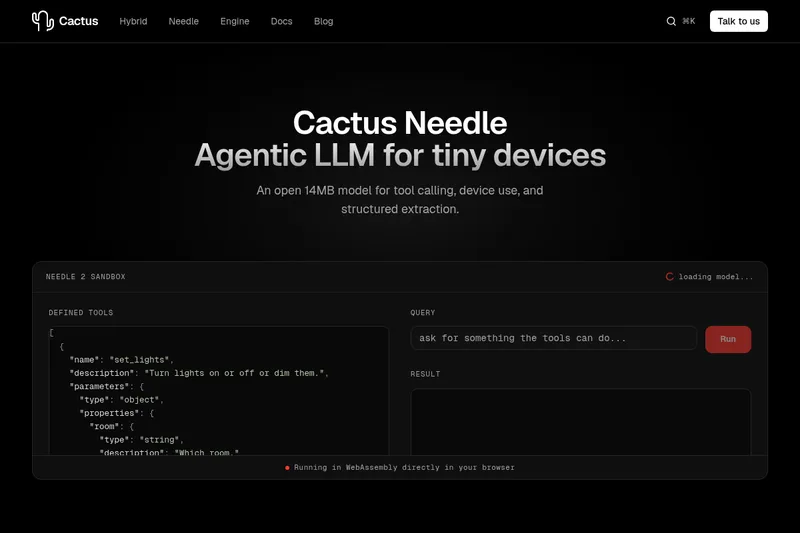
Needle 2 is an open, production-ready 45M-parameter agentic LLM from Cactus designed for tool calling, device control, and structured extraction on extremely small devices; the shipped CQ2-bit binary is ~14 MB and runs in ~28 MB of RAM across Cortex-M, microcontrollers, phones, Raspberry Pi and WebAssembly.
The cheapest GPU cloud
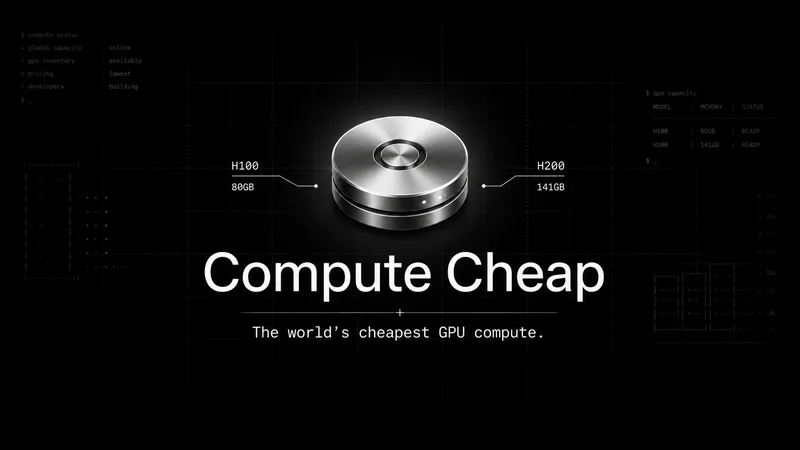
Compute Cheap provides low-cost GPU compute for training and inference, offering H100 and H200 SXM GPUs as interruptible or reserved capacity with published per-GPU-hour pricing and a simple request/reserve/run workflow.
Oodle.ai
Oodle Agent Observability provides agent/LLM observability at scale with S3-backed columnar storage, fast search (<1s P99), out-of-the-box AI-powered insights, and flat ingestion-based pricing designed to retain 100% of traces affordably for debugging and optimizing production agents.


Premium Alternatives
Abliterated LLM provider for cyber tasks
Refuseless hosts GLM 5.3 Abliterated models through an OpenAI-compatible API for cybersecurity and coding work. The page states that prompts are not retained and shows integrations with OpenCode and Pi.
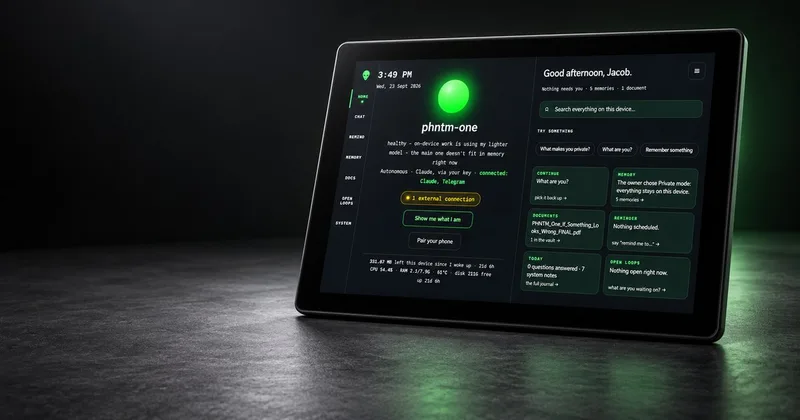
PHNTM ONE
PHNTM One is a private, local-first AI appliance: a hand-built desktop device (Raspberry Pi 5, 8 GB, 10.1″ touchscreen) that runs an on-device model (Gemma 3 4B) to provide a voice-capable assistant, memories, document reading, timers, Home Assistant integration and offline knowledge — sold as a one-time $549 purchase with no subscription and zero telemetry by default.
AletheionAGI
AletheionAGI provides a grounded-memory layer for AI systems that enforces evidence-bound delivery, namespace isolation, and policy authorization so AI readers cannot produce unsupported claims. It's targeted at production-facing use cases like customer support, commerce agents and internal copilots.

ClaudeThings
ClaudeThings provides a packaged, continuously-updating set of 89 specialized agents, 103 pre-built skills, and 181 slash commands that act as an AI engineering and marketing team for Claude Code — delivered as a private GitHub repo and installed with a single npx command. It adapts to any stack via a CLAUDE.md project manifest and is sold as a one-time purchase with lifetime updates.

Keybe AI (Keybe INC)
Keybe AI (Keybe INC) is an AI-powered sales suite that provides deployable 'AI salesperson' assistants and a Smart Chat sales platform (CDP, funnels, outbound, catalogs, metrics and flows) for businesses to automate customer service and increase conversions.