
AI21 Maestro
AI21 Maestro is an optimization framework for production AI agents that reduces cost and latency while preserving accuracy by routing, compressing, and decomposing requests and providing orchestration, validation, and data extraction features for enterprise agent workflows.
AI21 Maestro is ai agents software teams evaluate for ai agents. Use this page to review pricing, integration signals, and the best alternatives before you commit.
Profile facts come from the vendor source. AiMatch labels unknown pricing or API details instead of estimating them.
Review official source →Used in These Packs
Quick Overview
Best for: AI Agents
What it does
AI Agents software for decision-makers comparing workflow fit and alternatives.
Best fit
AI Agents
Pricing snapshot
Contact for pricing
Next step
Compare AI21 Maestro with similar tools before you shortlist it.
Compare this tool before you shortlist it
Review alternatives, pricing posture, and workflow fit side by side.
Maestro is an optimization framework from AI21 aimed at real-world, production AI agents. It focuses on reducing operational cost and latency while maintaining or improving accuracy by routing, compressing, and decomposing requests in flight. The product targets enterprise and R&D teams who need validated optimization (rather than guesswork) for multi-step, agentic workflows and long-horizon tasks. Maestro provides features such as dynamic planning and orchestration, advanced data ingestion and extraction (RAG), in-flow validation to verify and fix results, visual execution graphs for debugging, and spend attribution to teams, repos, and agents.
AI21 Labs provides AI solutions for complex tasks, document analysis, and workflow automation with usage-based pricing.
Own this listing?
Claim this page for a one-time $29 to add pricing, features, screenshots, verified owner details, and a clearly labeled 30-day category position after the profile is live.
Claim this listing for $29Key Features
Automatic budget & compute scaling (Alternative Paths)
Routes multiple parallel paths and automatically scales budget and compute so results stay within cost and latency budgets while paths compete to deliver the best outcome.
In-flow validation and Verified Results
Performs in-flow validation to boost accuracy and automatically fixes errors at each step before they cascade; includes visual execution graphs to trace, debug, and adjust workflows.
Advanced Data Ingestion & Extraction (RAG)
Offers advanced retrieval-augmented generation capabilities with data parsing that extracts structured information from ingested documents to improve retrieval accuracy.
Dynamic planning and orchestration
Turns complex tasks into multi-step plans on demand, enabling end-to-end execution when you plug in data and tools and define budgets.
Cost attribution and spend visibility
Attributes spend to the team, repository, and agent responsible, allowing organizations to see where every dollar goes and identify recoverable waste.
Request-level optimization (routing, compression, decomposition)
Optimizes live requests by routing, compressing, and decomposing them in flight to cut recoverable spend without changing existing code or degrading quality.
Pricing
Current pricing details are not available from the vendor source.
Use Cases
Enterprise production agents
Optimize cost, accuracy, and latency of enterprise-grade agents operating in production, with features for verification, orchestration, and spend attribution.
R&D acceleration
Helps R&D teams reduce the time spent tuning and validating agent workflows by providing automated optimization, visual debugging, and validated trade-off mapping.
Long-horizon agentic tasks
Supports complex, multi-step agent tasks and long-context workflows by providing dynamic planning, execution graphs, and test-time compute orchestration.
Data-driven retrieval and extraction
Improves retrieval accuracy for knowledge and document workstreams through advanced RAG capabilities and structured data extraction from ingested documents.
Integrations
No verified integration details are available.
Benefits
Limitations
No verified limitations are available.
Frequently Asked Questions
No verified FAQs are available.
Getting Started
- 1 Step 1: Contact AI21 via the Contact Us link to discuss Maestro for your organization.
- 2 Step 2: Plug in your data and tools and connect your agent workflows to Maestro.
- 3 Step 3: Define your cost, latency, and accuracy budget and start execution to let Maestro optimize and validate results end to end.
Support
Contact form
Engage sales or product teams via the Contact Us link on the AI21 website to discuss Maestro deployment and trials.
Documentation / Trust Center
Security, privacy, and compliance information is available via the site ("More about security", Trust Center) and a vulnerability reporting mechanism is provided.
API
Compare AI21 Maestro with similar tools
See how it stacks up against alternatives
Related Tools
View all 656 →
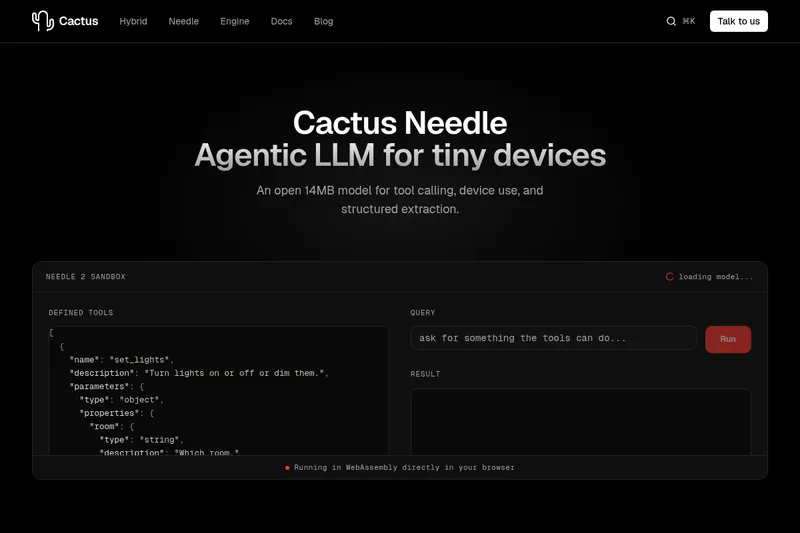
Needle2
Needle 2 is an open, production-ready 45M-parameter agentic LLM from Cactus designed for tool calling, device control, and structured extraction on extremely small devices; the shipped CQ2-bit binary is ~14 MB and runs in ~28 MB of RAM across Cortex-M, microcontrollers, phones, Raspberry Pi and WebAssembly.

The cheapest GPU cloud
Compute Cheap provides low-cost GPU compute for training and inference, offering H100 and H200 SXM GPUs as interruptible or reserved capacity with published per-GPU-hour pricing and a simple request/reserve/run workflow.
Oodle.ai
Oodle Agent Observability provides agent/LLM observability at scale with S3-backed columnar storage, fast search (<1s P99), out-of-the-box AI-powered insights, and flat ingestion-based pricing designed to retain 100% of traces affordably for debugging and optimizing production agents.


Premium Alternatives
Abliterated LLM provider for cyber tasks
Refuseless hosts GLM 5.3 Abliterated models through an OpenAI-compatible API for cybersecurity and coding work. The page states that prompts are not retained and shows integrations with OpenCode and Pi.

PHNTM ONE
PHNTM One is a private, local-first AI appliance: a hand-built desktop device (Raspberry Pi 5, 8 GB, 10.1″ touchscreen) that runs an on-device model (Gemma 3 4B) to provide a voice-capable assistant, memories, document reading, timers, Home Assistant integration and offline knowledge — sold as a one-time $549 purchase with no subscription and zero telemetry by default.
AletheionAGI
AletheionAGI provides a grounded-memory layer for AI systems that enforces evidence-bound delivery, namespace isolation, and policy authorization so AI readers cannot produce unsupported claims. It's targeted at production-facing use cases like customer support, commerce agents and internal copilots.

ClaudeThings
ClaudeThings provides a packaged, continuously-updating set of 89 specialized agents, 103 pre-built skills, and 181 slash commands that act as an AI engineering and marketing team for Claude Code — delivered as a private GitHub repo and installed with a single npx command. It adapts to any stack via a CLAUDE.md project manifest and is sold as a one-time purchase with lifetime updates.
maccopilot
MacCopilot is a native macOS app that lets users select part of their screen and ask AI models about its contents. It connects to providers such as OpenAI, Anthropic, Google Gemini, Ollama, and compatible endpoints using the user’s own provider account or local server.