
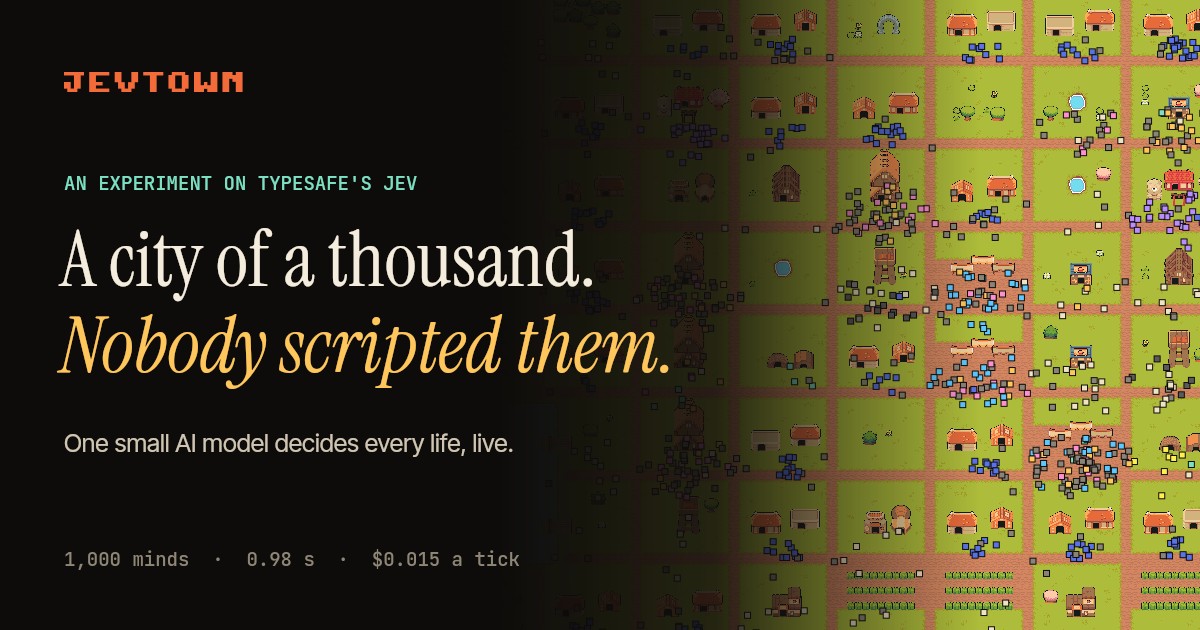
Jevtown
Jevtown is a live interactive city simulation of 1,000 citizens driven by a single small AI model called Jev (jev-1.13.0). Visitors can claim a citizen, observe recorded live runs, vote on futures, and use the demo and field guide to lift Jev’s decision-patterns into products.
Jevtown is ai tools software teams evaluate for ai agents. Use this page to review pricing, integration signals, and the best alternatives before you commit.
Profile facts come from the vendor source. AiMatch labels unknown pricing or API details instead of estimating them.
Review official source →Quick Overview
Best for: AI Agents
What it does
AI Tools software for decision-makers comparing workflow fit and alternatives.
Best fit
AI Agents
Pricing snapshot
Paid from Per-request/per-pattern pricing based on measured runs
Next step
Compare Jevtown with similar tools before you shortlist it.
Compare this tool before you shortlist it
Review alternatives, pricing posture, and workflow fit side by side.
Jevtown is an interactive test rig: a simulated city of 1,000 citizens whose next actions are decided every tick by a single small AI model named Jev (jev-1.13.0). The public demo runs live and also exposes recorded runs and logs so visitors can replay decisions, inspect timings, costs and the model’s probabilities. The project is presented as a demo and a set of reusable patterns for developers and product teams who want to use a lightweight judgment model for tasks such as triage, moderation, panel judgments, profiling, and agent behavior. Visitors can claim a citizen (via X), observe the city's decisions, vote on futures, and read the study and field guide to apply the measured patterns to their own products.
10,000 AI readers react to your post before you publish it Discussion | Link
Own this listing?
Claim this page for a one-time $29 to add pricing, features, screenshots, verified owner details, and a clearly labeled 30-day category position after the profile is live.
Claim this listing for $29Key Features
Population-scale decisions
One request can ask the model what each of 1,000 people will do next (1,000 minds a tick), with measured latency (0.98 s median) and cost ($0.015 per full city tick).
Counterfactual futures (copy-and-run)
Before visitors vote, the world is copied and a candidate event is run in the copy; everyone who would witness it is asked what they would do, enabling low-cost counterfactual polling (≈0.6 s per future, a third of a cent).
Small-model judgments only
Jev is described as a System One model that supplies judgments (categorical probabilities for options) rather than producing text or numerics; the model answers plain phrases that game code supplies.
Replayable logs
Runs can be replayed from logs without calling the model again; timings, draws and costs are recorded and replayed exactly as measured during the live run.
Panel/jury judgments
The system can seat twelve citizens as jurors, ask each once whether they would vote guilty, and combine probabilistic votes into a verdict (measured 560 ms per jury).
Typed-event front door
Visitors can type free text events; Jev reads them into a typed event so free text is translated into structured, code-run actions.
Safety screening and moderation
Every message is screened individually for abuse, spam and private details before reaching citizens; the site reports measured block rates for harmful lines and thresholds for hiding hateful handles.
Measured cost and performance ledger
The project publishes measured costs (per-request, per-tick), latency percentiles, total request counts, token usage, and an overall ledger of the experiment's compute and evaluation costs.
Ownership & gamified interaction
Visitors are handed and may claim one citizen (1,000 total) via X; owners score by predicting what their citizen will do next and can participate in the live board.
Pricing
Free to try the live city in the browser; no account needed to view replays. Claiming a citizen requires signing in with X.
Pay-as-you-go (measured unit pricing)
Per-request/per-pattern pricing based on measured runs- 1,000 people asked about next action: $0.015 per full-city tick (median 0.98 s).
- Counterfactual future (copy-and-run): ~0.6 s and a third of a cent per future.
- Free-text sentence -> typed event: $0.0001 per sentence (reported).
- Moderation example: $0.018 per 1,000 (reported) and 8,000-character judgments for $0.012 (reported).
Full-experiment cost (example)
$21.64- Reported total cost to reproduce the public experiment’s runs and evaluations (ledger).
Use Cases
Triage, routing and bulk decisions
Send a large batch (shared context) and ask one question per item (1,000 for $0.015) to surface probabilities across many items at once.
Counterfactual polling
Copy world state, change one fact and re-run to measure how behavior would change (the 'future' mechanism).
Moderation gate
A safe front door that screens each message alone for abuse or private data before it reaches downstream systems or users.
Panel-based decisions and juries
Aggregate multiple individual judgments (e.g., 12 jurors) into a single verdict with measured latency and margins.
Agents, characters and game NPCs
Produce typed actions with odds for agents and characters; sample those actions in code and replay without calling the model.
Bulk profiling and columns
Turn judgments into filterable columns for analysis and product logic (bulk profiling for many individuals).
Integrations
X (sign-in)
Visitors sign in with X to claim ownership of a citizen inside Jevtown.
Claude (Anthropic) noted in engineering
The project reports it was engineered with Claude (Fable 5.1) in Claude Code during development.
Benefits
Limitations
Frequently Asked Questions
No verified FAQs are available.
Getting Started
- 1 Enter Jevtown (https://jevtown.com/) and load the live city or replay recorded days.
- 2 Claim a citizen when prompted by signing in with your X account (one owner per citizen; 1,000 total).
- 3 Observe the live/replayed run: inspect probabilities, timings and draws for each decision and try rolling the dice against those odds.
- 4 Use the field guide and cost calculator ('Build with Jev') to prototype how Jev’s patterns map to your product.
Support
docs
Jev: documentation and 'Jev explained' pages linked from the site for technical and conceptual guidance.
study
The site publishes a study, field guide, ledgers and evaluation methodology for reproducibility and deeper inspection.
site
Primary access and demonstration are via the main site (https://jevtown.com/).
API
Compare Jevtown with similar tools
See how it stacks up against alternatives
Related Tools
View all 651 →
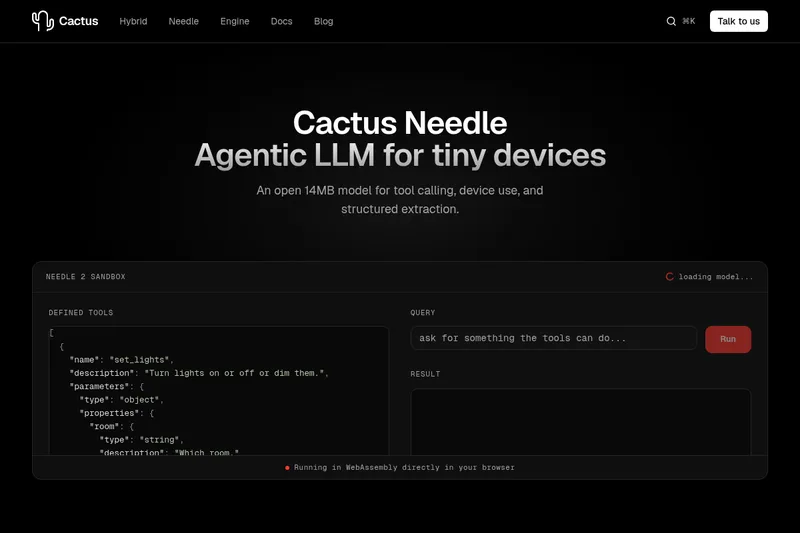
Needle2
Needle 2 is an open, production-ready 45M-parameter agentic LLM from Cactus designed for tool calling, device control, and structured extraction on extremely small devices; the shipped CQ2-bit binary is ~14 MB and runs in ~28 MB of RAM across Cortex-M, microcontrollers, phones, Raspberry Pi and WebAssembly.
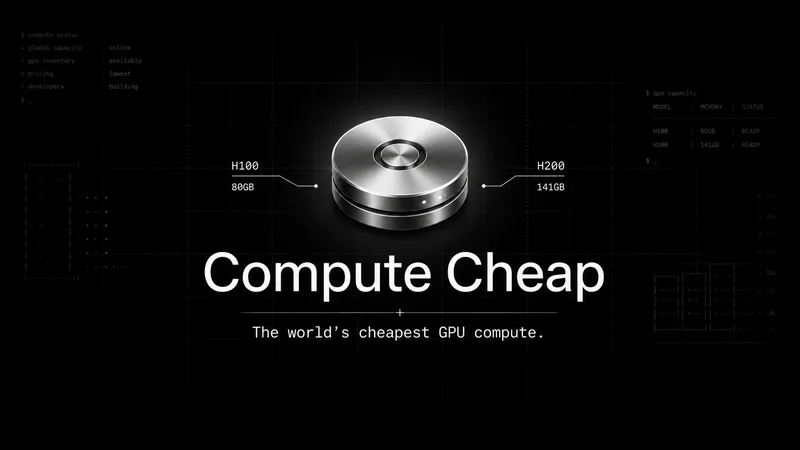
The cheapest GPU cloud
Compute Cheap provides low-cost GPU compute for training and inference, offering H100 and H200 SXM GPUs as interruptible or reserved capacity with published per-GPU-hour pricing and a simple request/reserve/run workflow.

Oodle.ai
Oodle Agent Observability provides agent/LLM observability at scale with S3-backed columnar storage, fast search (<1s P99), out-of-the-box AI-powered insights, and flat ingestion-based pricing designed to retain 100% of traces affordably for debugging and optimizing production agents.


Budget-Friendly Alternatives
The cheapest GPU cloud
Compute Cheap provides low-cost GPU compute for training and inference, offering H100 and H200 SXM GPUs as interruptible or reserved capacity with published per-GPU-hour pricing and a simple request/reserve/run workflow.
Oodle.ai
Oodle Agent Observability provides agent/LLM observability at scale with S3-backed columnar storage, fast search (<1s P99), out-of-the-box AI-powered insights, and flat ingestion-based pricing designed to retain 100% of traces affordably for debugging and optimizing production agents.

Personal Context MCP
Lanes Link (Personal Context MCP) is a private, self‑hostable middleware control plane that connects your accounts, memories and skills to every AI agent you use via a single endpoint and configurable Access Profiles.
