
AQ
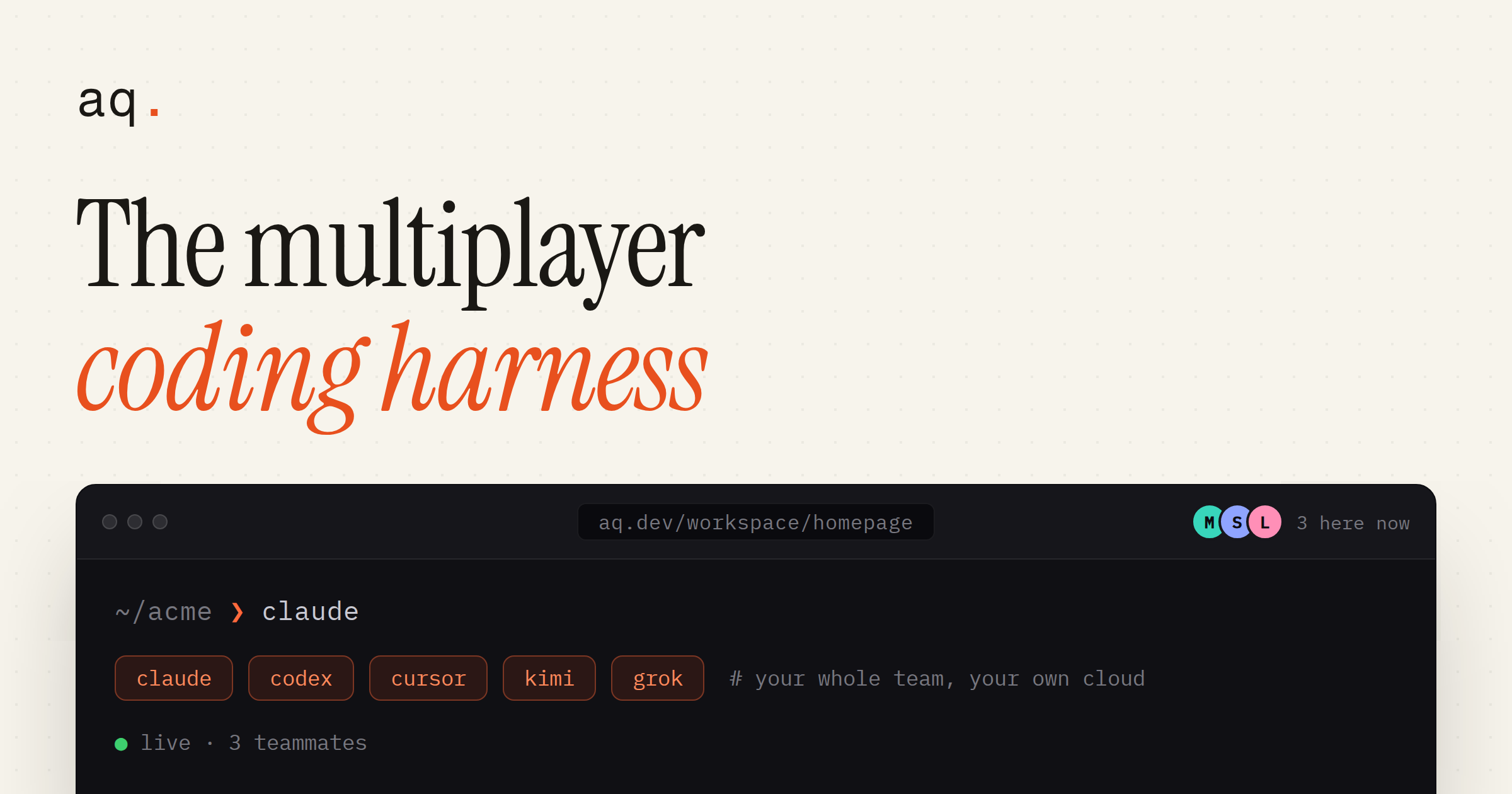
AQ is a multiplayer agentic development environment that lets engineering teams run AI coding agents (Claude Code, Codex, Cursor, etc.) together with shared live terminals, a collaborative code editor, and live app previews, running on your own cloud, a dedicated AQ-managed VM, or a free personal sandbox.
AQ is ai agents software teams evaluate for software & gaming. Use this page to review pricing, integration signals, and the best alternatives before you commit.
Profile facts come from the vendor source. AiMatch labels unknown pricing or API details instead of estimating them.
Review official source →Used in These Packs
Quick Overview
Best for: Software & Gaming
What it does
AI Agents software for decision-makers comparing workflow fit and alternatives.
Best fit
Software & Gaming
Pricing snapshot
Freemium from No seat charge; includes a private AQ-managed sandbox and $5 in AQ model credits
Next step
Compare AQ with similar tools before you shortlist it.
Compare this tool before you shortlist it
Review alternatives, pricing posture, and workflow fit side by side.
AQ is a multiplayer, agentic development environment designed for engineering teams to run AI coding agents collaboratively. It provides shared live terminals, a collaborative code editor, persistent workspaces, and live app previews that stream from the running dev server. AQ runs where you are: on VMs in your own cloud, on a dedicated AQ-managed VM, or in a free AQ-managed personal sandbox, and it emphasizes running agents with each person's own accounts and dedicated execution infrastructure rather than multi-tenant shared runtime.
AQ targets engineers, product managers, and designers working together with coding agents: it supports real agent CLIs (Claude Code, Codex, Cursor, etc.), integrates with team workflows (Linear and Git/GitHub-based PRs), and offers features for parallel isolated workspaces, persistent sessions, and live review to streamline from issue to pull request.
AQ is the multiplayer agentic development environment: your whole team and every agent CLI in live shared workspaces, on infrastructure you control.
Own this listing?
Claim this page for a one-time $29 to add pricing, features, screenshots, verified owner details, and a clearly labeled 30-day category position after the profile is live.
Claim this listing for $29Key Features
Multiplayer live terminals & shared keyboard
Teammates open a workspace and watch the same live terminal; one-click handoff lets someone type as you while you retain your own input and you can revoke control at any time.
Isolated git worktrees per task
Each task gets its own isolated git worktree so parallel agents and workspaces don't interfere; dependencies install automatically and you can rebase onto main with one click.
Persistent sessions (tmux) and parallel workspaces
Sessions run in persistent tmux on the VM so work continues when devices disconnect; parallel workspaces allow concurrent tasks on the same repository.
Live app previews & shareable links
A workspace can run its dev server and stream the running app next to the agent; Team plan supports shareable preview links that open without an account for viewing and support pinned comments on the page.
Agent CLI integration
Supports signing in to agent CLIs (Claude Code, Codex, Cursor Agent and others) with each person’s own accounts; agents can commit, push, and open pull requests using each person's GitHub auth.
Flexible execution: sandbox, managed VM, or your cloud
Run on a private AQ-managed sandbox (free), a dedicated AQ-managed VM for teams, or connect VMs from your own cloud account; AQ states it does not use shared multi-tenant execution infrastructure.
AQ Models and credits
During early access, AQ provides a free sandbox with $5 in AQ model credits and offers AQ Models (e.g., GLM 5.2) that consume AQ credits when used through AQ’s gateway.
Linear integration and PR workflow
Label a Linear issue ai-task to create a workspace tracked in the team sidebar; work and PR status sync both ways and agents produce PRs using each person's GitHub credentials.
Pricing
Personal AQ-managed sandbox with no seat charge and $5 in AQ model credits; model usage is separate from the free sandbox.
Free (Early access personal sandbox)
No seat charge; includes a private AQ-managed sandbox and $5 in AQ model credits- One-person private AQ-managed sandbox
- Nothing to install
- $5 in AQ credits for AQ Models (model usage separate from agent subscriptions)
Team (Early access)
$50 per user per month (during early access)- Adds teammates and sharing
- Choice of VMs in your own cloud or a dedicated, always-on VM managed by AQ
- Shareable live previews and team features
Use Cases
Collaborative agent-driven coding
Teams run AI coding agents together while multiple people observe, steer, and step into live terminals and editors.
Agent-assisted code review
Use agents to review code and have teammates step into the same live session to address findings together.
Paired debugging and onboarding
Debugging together with live terminals and app previews, and onboarding engineers by giving them a persistent sandboxed workspace.
Issue-to-PR workflow
Label Linear issues to spawn workspaces, let agents work and commit, and produce pull requests tracked back to the workspace for a direct path from issue to PR.
Integrations
Claude Code / OpenAI (Codex) / Cursor / other agent CLIs
Sign in to these agent CLIs with your own accounts to run agents inside AQ; AQ does not proxy or mark up usage from those agent subscriptions.
AQ Models (e.g., GLM 5.2)
AQ provides its own models accessed through AQ's gateway which consume AQ credits; available as an alternative to using personal agent subscriptions.
Linear
Label a Linear issue ai-task to create a tracked workspace; status syncs both ways as work moves between Linear and the workspace.
GitHub
Agents commit, push, and open pull requests using each person's GitHub authentication so PRs originate under individual accounts.
Benefits
Limitations
Frequently Asked Questions
What is included in the Free plan?
Do I need my own Claude or OpenAI subscription?
Where does my code run?
Is AQ an agentic development environment?
What happens when I click “Start free”?
Getting Started
- 1 Step 1: Connect an environment — start free in the personal sandbox AQ creates for you, or subscribe to run on your own cloud or a dedicated AQ-managed VM.
- 2 Step 2: Sign in to your agents — authenticate Claude Code, Codex, Cursor Agent, or other agent CLIs with your existing agent accounts (AQ does not proxy or mark up that usage).
- 3 Step 3: Build together live — open workspaces (one git worktree per task), use shared live terminals and the editor, run the dev server for live previews, and invite teammates with a link.
Support
Sales / Inquiries
Talk to sales link available on the site (https://aq.dev/).
AQ emails users when workspaces are ready and uses work-email sign-in; requests are personally reviewed.
Documentation
Docs and API guides are listed in the site navigation (Docs, API, Guides).
API
API and Guides referenced in site navigation (see https://aq.dev/)
Compare AQ with similar tools
See how it stacks up against alternatives
Related Tools
View all 608 →
Needle2
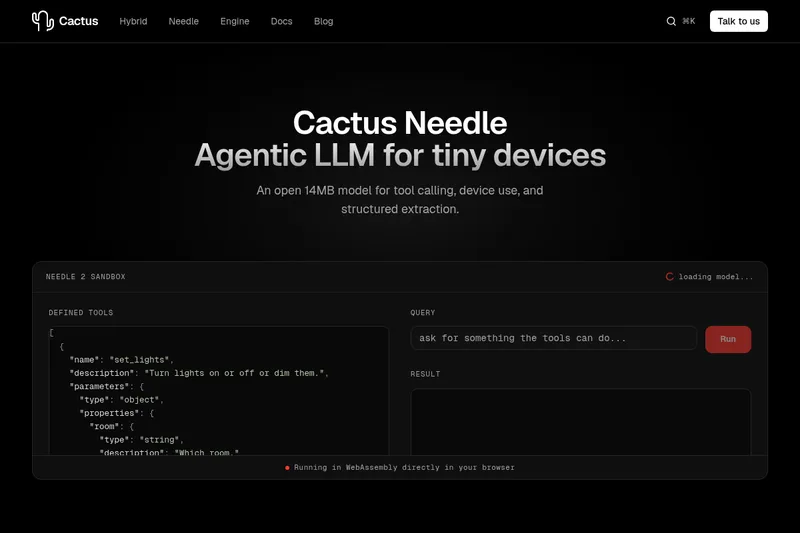
Needle 2 is an open, production-ready 45M-parameter agentic LLM from Cactus designed for tool calling, device control, and structured extraction on extremely small devices; the shipped CQ2-bit binary is ~14 MB and runs in ~28 MB of RAM across Cortex-M, microcontrollers, phones, Raspberry Pi and WebAssembly.
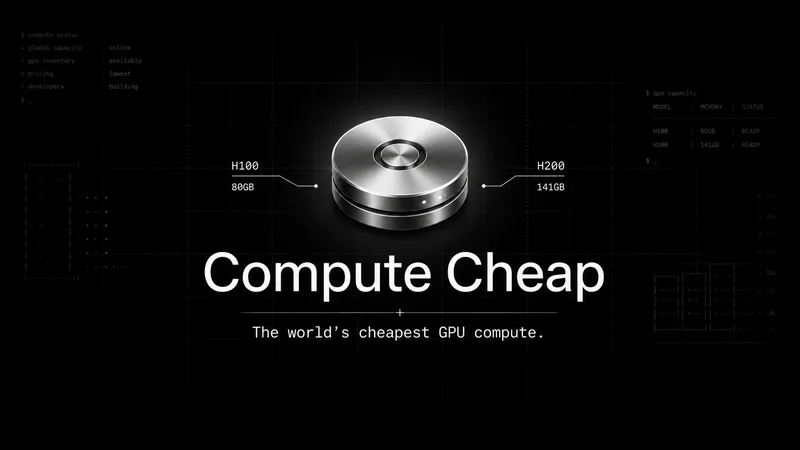
The cheapest GPU cloud
Compute Cheap provides low-cost GPU compute for training and inference, offering H100 and H200 SXM GPUs as interruptible or reserved capacity with published per-GPU-hour pricing and a simple request/reserve/run workflow.
Oodle.ai
Oodle Agent Observability provides agent/LLM observability at scale with S3-backed columnar storage, fast search (<1s P99), out-of-the-box AI-powered insights, and flat ingestion-based pricing designed to retain 100% of traces affordably for debugging and optimizing production agents.


Premium Alternatives
Abliterated LLM provider for cyber tasks
Refuseless hosts GLM 5.3 Abliterated models through an OpenAI-compatible API for cybersecurity and coding work. The page states that prompts are not retained and shows integrations with OpenCode and Pi.
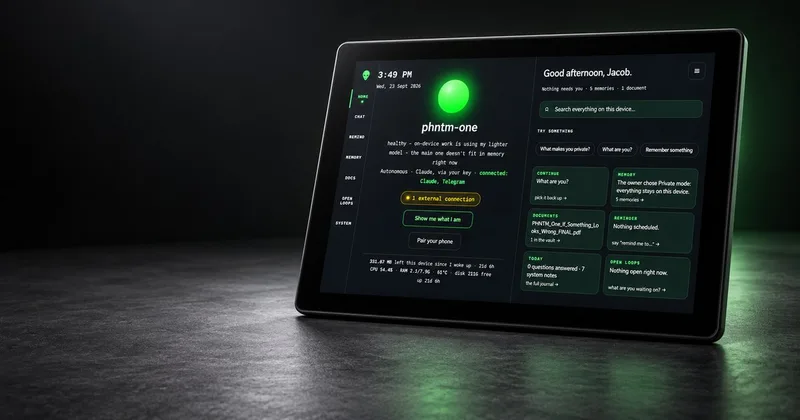
PHNTM ONE
PHNTM One is a private, local-first AI appliance: a hand-built desktop device (Raspberry Pi 5, 8 GB, 10.1″ touchscreen) that runs an on-device model (Gemma 3 4B) to provide a voice-capable assistant, memories, document reading, timers, Home Assistant integration and offline knowledge — sold as a one-time $549 purchase with no subscription and zero telemetry by default.
AletheionAGI
AletheionAGI provides a grounded-memory layer for AI systems that enforces evidence-bound delivery, namespace isolation, and policy authorization so AI readers cannot produce unsupported claims. It's targeted at production-facing use cases like customer support, commerce agents and internal copilots.
ClaudeThings
ClaudeThings provides a packaged, continuously-updating set of 89 specialized agents, 103 pre-built skills, and 181 slash commands that act as an AI engineering and marketing team for Claude Code — delivered as a private GitHub repo and installed with a single npx command. It adapts to any stack via a CLAUDE.md project manifest and is sold as a one-time purchase with lifetime updates.

Customerly Aura
Customerly Aura is an AI customer-support agent that uses company knowledge and customer data to resolve tickets, take actions such as processing refunds, and escalate issues to human agents when needed. It works across live chat, email, WhatsApp, Facebook Messenger, and mobile apps.

qomplement
qomplement is an Agentic AI-driven ERP built for supply chain and operations teams that automates tasks across procurement, inventory, freight, finance, and planning to reduce manual work and scale operations without adding headcount.