
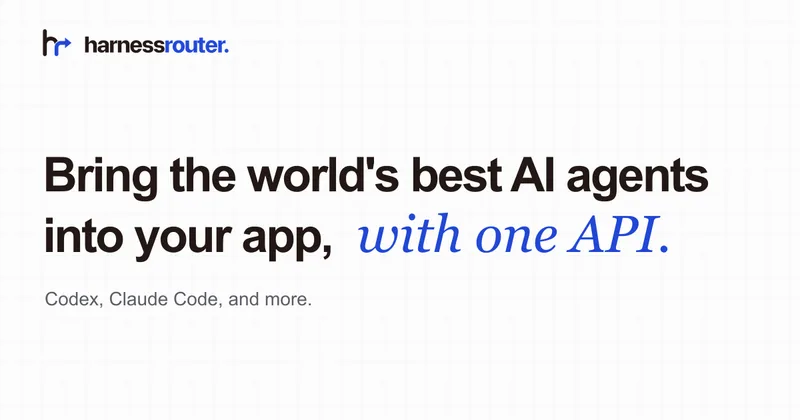
HarnessRouter
HarnessRouter is a managed AI-agent backend that brings leading code-capable models (Codex, Claude Code, Hermes, etc.) into apps via a single API, handling runtime, tooling, sandboxing, permissions, and maintenance so teams can ship agent-driven features quickly.
HarnessRouter is ai tools software teams evaluate for software & gaming. Use this page to review pricing, integration signals, and the best alternatives before you commit.
Profile facts come from the vendor source. AiMatch labels unknown pricing or API details instead of estimating them.
Review official source →Used in These Packs
Quick Overview
Best for: Software & Gaming
What it does
AI Tools software for decision-makers comparing workflow fit and alternatives.
Best fit
Software & Gaming
Pricing snapshot
Paid from Not listed on page
Next step
Compare HarnessRouter with similar tools before you shortlist it.
Compare this tool before you shortlist it
Review alternatives, pricing posture, and workflow fit side by side.
HarnessRouter provides a managed AI-agent backend that lets developers integrate agent-driven features into their products via a single API. It exposes harnesses — the execution layer around models that includes instructions, policies, tools, runtime, sandbox, permissions, and output contracts — so models can perform work and return structured artifacts (code, files, images, rendered videos) rather than only text. The service handles upgrades, fixes, runtime, tool orchestration, sessions, streaming, retries, timeouts, permissions, cost controls, and observability, enabling teams to ship agent-backed features in minutes instead of building and maintaining a complex backend for months. The product is positioned for developer and product teams and is backed by Y Combinator.
Bring the world's best AI agents into your app, with one API Discussion | Link
Own this listing?
Claim this page for a one-time $29 to add pricing, features, screenshots, verified owner details, and a clearly labeled 30-day category position after the profile is live.
Claim this listing for $29Key Features
Single API for multiple agent harnesses
One API that routes to leading agent-capable models such as Codex, Claude Code, and Hermes so your app can swap harnesses (e.g., 'claude-code' or 'codex') via configuration without changing integration code.
Managed AI agent backend
HarnessRouter runs and maintains the agent execution backend for you — upgrades, fixes, and maintenance are handled by the platform.
Harness abstraction
A 'harness' is the execution layer (instructions, model policy, tools, MCP, skills, runtime and sandbox, permissions and guardrails, and output contract) that lets a model produce real artifacts.
Operational controls and observability
Trace every task step-by-step, configure each harness, and see execution timelines and event logs for agent runs.
Runtime features and reliability
Platform handles sessions & streaming, retries & timeouts, tool orchestration, files & artifacts, permissions, and cost controls.
Structured, renderable outputs
Agents return structured results such as reviewable code diffs, generated files and documents, images, and confirmations of tool actions (e.g., GitHub, Slack, Notion, internal APIs).
Pricing
7-day trial
Developer
Not listed on page- Monthly platform plan option (Developer)
- Includes credits for production agent work
Production
Not listed on page- Monthly platform plan option (Production)
- Includes credits for production agent work
Scale
Not listed on page- Monthly platform plan option (Scale)
- Includes credits for production agent work, budgets and hard caps
Use Cases
Website features and site builders
Generate or modify site content, code, and assets via an agent-driven backend integrated into a web product.
Digital employee / automation
Automate operational workflows, content generation, or internal tooling using agents that run tasks and return artifacts.
Model evaluation and developer tooling
Wire coding agents (e.g., Codex, Claude Code) into development workflows for automated code generation, diffs, and artifact output.
Creative production (video, game, film)
Example provided: 'Cinematic Product Launch Video Generator' where an agent produces a launch-video MP4 as a renderable artifact.
Legal, social, planning, data, ads
Support for domain workflows like document generation, planning, data operations, ad copy and asset generation through agent outputs.
Integrations
Codex
Supported code-capable model harness for generating code, apps, and images.
Claude Code
Supported code-capable model harness for code, files and documents.
Hermes
Supported model harness for autonomous or frontier model usage.
GitHub
Agents can perform and confirm real tool actions such as GitHub operations (commits, PRs) that are returned to your app.
Slack / Notion
Agents can confirm actions against external collaboration tools (Slack, Notion) or internal APIs.
Discord / LinkedIn
Platform references community and social integrations (Discord, LinkedIn) on the site.
Benefits
Limitations
Frequently Asked Questions
What exactly is a harness?
Why not just use Codex or Claude directly?
How much does it cost?
Do I need to understand agents to use this?
Am I locked into one harness?
What exactly comes back to my app?
Getting Started
- 1 Sign up on the site and Get API key.
- 2 Read the documentation and drop AGENTS.md into your coding environment (Cursor or Claude Code) to wire an agent.
- 3 Add your API key securely (example: set HR_KEY=sk-••••••••) and call the HarnessRouter API to run a harness in your product.
Support
docs
Read docs (link on the site) to learn API and harness usage.
signup
Sign up on the site to get an API key and start the 7-day trial.
community
Social/community presence referenced (Discord, LinkedIn) for community engagement.
API
Read docs on the HarnessRouter site (link labeled 'Read docs')
Compare HarnessRouter with similar tools
See how it stacks up against alternatives
Related Tools
View all 651 →
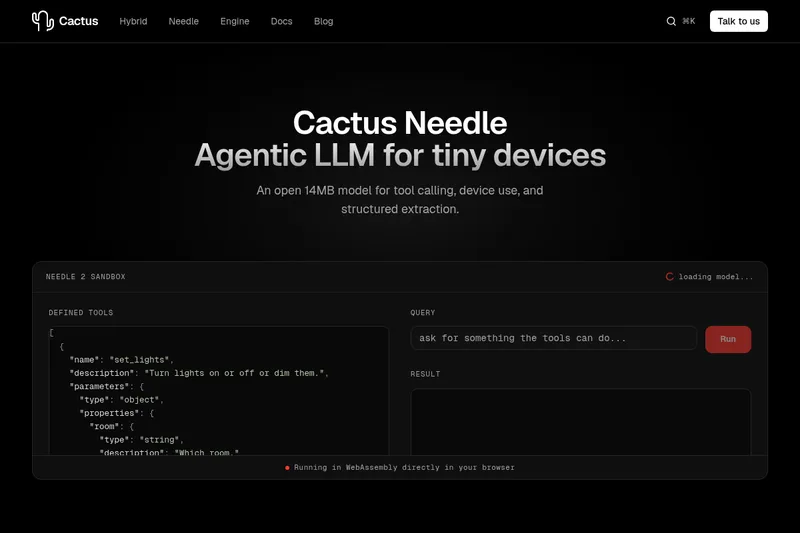
Needle2
Needle 2 is an open, production-ready 45M-parameter agentic LLM from Cactus designed for tool calling, device control, and structured extraction on extremely small devices; the shipped CQ2-bit binary is ~14 MB and runs in ~28 MB of RAM across Cortex-M, microcontrollers, phones, Raspberry Pi and WebAssembly.
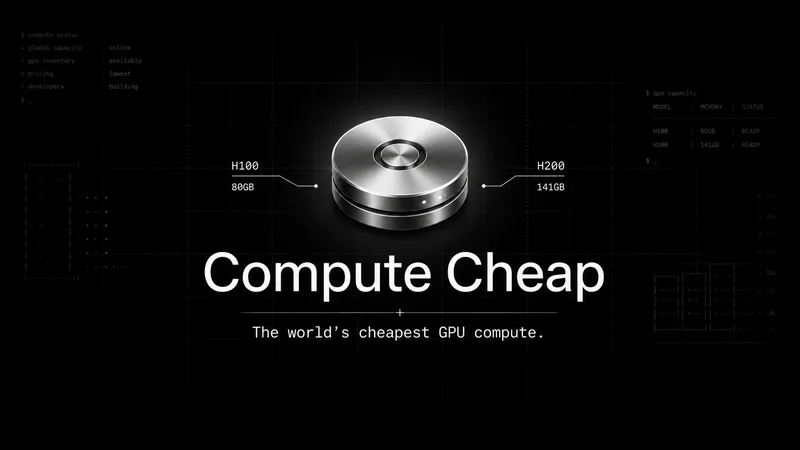
The cheapest GPU cloud
Compute Cheap provides low-cost GPU compute for training and inference, offering H100 and H200 SXM GPUs as interruptible or reserved capacity with published per-GPU-hour pricing and a simple request/reserve/run workflow.
Oodle.ai
Oodle Agent Observability provides agent/LLM observability at scale with S3-backed columnar storage, fast search (<1s P99), out-of-the-box AI-powered insights, and flat ingestion-based pricing designed to retain 100% of traces affordably for debugging and optimizing production agents.


Budget-Friendly Alternatives
The cheapest GPU cloud
Compute Cheap provides low-cost GPU compute for training and inference, offering H100 and H200 SXM GPUs as interruptible or reserved capacity with published per-GPU-hour pricing and a simple request/reserve/run workflow.
Oodle.ai
Oodle Agent Observability provides agent/LLM observability at scale with S3-backed columnar storage, fast search (<1s P99), out-of-the-box AI-powered insights, and flat ingestion-based pricing designed to retain 100% of traces affordably for debugging and optimizing production agents.
Personal Context MCP
Lanes Link (Personal Context MCP) is a private, self‑hostable middleware control plane that connects your accounts, memories and skills to every AI agent you use via a single endpoint and configurable Access Profiles.
%22%2F%3E%20%3Ctext%20x%3D%2250%25%22%20y%3D%2250%25%22%20dominant-baseline%3D%22central%22%20text-anchor%3D%22middle%22%20font-family%3D%22system-ui%2C-apple-system%2Csans-serif%22%20font-weight%3D%22700%22%20font-size%3D%2250%22%20fill%3D%22white%22%3EL%3C%2Ftext%3E%20%3C%2Fsvg%3E)