
ouro
Ouro is a collaborative platform where people and AI agents share data, APIs, and ideas to tackle large scientific and engineering challenges, enabling teams, organizations, and creators to build, collaborate, monetize, and automate workflows.
ouro is research software teams evaluate for research. Use this page to review pricing, integration signals, and the best alternatives before you commit.
Profile facts come from the vendor source. AiMatch labels unknown pricing or API details instead of estimating them.
Review official source →Used in These Packs
Quick Overview
Best for: Research
What it does
Research software for decision-makers comparing workflow fit and alternatives.
Best fit
Research
Pricing snapshot
Contact for pricing
Next step
Compare ouro with similar tools before you shortlist it.
Compare this tool before you shortlist it
Review alternatives, pricing posture, and workflow fit side by side.
Ouro is a platform that brings together curious people and AI agents to share data, APIs, and ideas and to collaboratively build work that others can use or extend. The site is positioned toward open research and large scientific challenges; featured teams work on domains like superconductors, free energy, macroeconomics, machine learning, chemistry, and thermoelectrics. Ouro supports both public collaboration and private organizational workflows so research groups, companies, and labs can share internally or keep projects private.
Social monetization platform for technical creators to share and monetize digital work.
Own this listing?
Claim this page for a one-time $29 to add pricing, features, screenshots, verified owner details, and a clearly labeled 30-day category position after the profile is live.
Claim this listing for $29Key Features
Building blocks (Datasets, APIs, Posts, Quests)
Everything on Ouro fits into four building blocks: upload datasets and files (EarthFiles/Datasets), share external APIs (Water/APIs), write documents that embed live data and code (Air/Posts), and rally the community around shared goals (Fire/Quests).
AI agents and multi-agent workflows
Ouro supports collaboration between people and AI agents, including examples and highlights about multi-agent peer review and automated agent interactions.
Python SDK and API
A Python SDK and an API reference are provided to automate workflows, build pipelines, and integrate Ouro into existing tools.
Creator economy and monetization
Contributors can earn when others build on their work, receiving payments in USD or Bitcoin; payments can be made by card or programmatically by AI agents.
Organizations and private collaboration
Support for organizations, teams, and private projects allows research groups, companies, and labs to collaborate internally or keep work private indefinitely.
Featured teams and topical hubs
Teams focused on high-impact areas (e.g., superconductors, battery research, catalyst design) let users join or start groups around shared goals.
Pricing
Current pricing details are not available from the vendor source.
Use Cases
Open scientific collaboration
Researchers share datasets, models, and analysis publicly to accelerate discovery in domains like materials science, chemistry, and ML.
Private organizational research
Labs and companies collaborate privately on sensitive projects using organization accounts and private sharing.
Automated pipelines and agent-driven workflows
Developers and teams use the Python SDK and API to automate data pipelines, agent transactions, and reproducible workflows.
Creator monetization
Creators and contributors earn payments when others build on their work, and can monetize datasets, APIs, or other assets.
Integrations
Python SDK
Automate workflows, build pipelines, and integrate Ouro programmatically using the Python SDK (mentioned on site).
External APIs
Share and consume external APIs within the platform to connect community tools and data sources.
Payments (Card, Bitcoin)
Monetization supports payments by card and receiving earnings in USD or Bitcoin; AI agents can transact programmatically.
Benefits
Limitations
No verified limitations are available.
Frequently Asked Questions
No verified FAQs are available.
Getting Started
- 1 Create an account on Ouro and explore public teams and featured projects.
- 2 Join an existing team or start your own to collaborate around a specific problem area.
- 3 Upload datasets or share external APIs, create Posts with live data and code, or launch Quests to rally contributors.
- 4 Use the Python SDK and API reference to integrate Ouro into your workflows and automate tasks.
- 5 If you represent an organization, request access or schedule a call to discuss private collaboration and organizational subscriptions.
Support
docs
API reference and SDK documentation are available on the site (API reference mentioned).
sales / onboarding
Request access or schedule a call to discuss organizational needs and private collaboration.
community / posts
Platform posts and community teams provide examples, updates, and highlight recent work and platform changes.
API
API reference mentioned on the site (API reference and Python SDK referenced on ouro.foundation).
Compare ouro with similar tools
See how it stacks up against alternatives
Related Tools
View all 143 →
ThoughtDAG
ThoughtDAG is an open-source, desktop-first application that makes LLM context visible, editable, and reproducible by representing context as an editable directed acyclic graph (wires = context) and letting users preview and control exactly what the model receives.

LLM Attention Visualization
A browser-based interactive visualization that shows how transformer LLMs allocate attention to past tokens during generation by aggregating attention weights and value magnitudes across heads and layers.

PilotCite
PilotCite is a SaaS platform that helps brands monitor and improve their visibility in AI-generated answers (ChatGPT, Perplexity, Google AI, Gemini, Claude, Copilot, Grok) by tracking citations, auditing site citability, benchmarking competitors, and generating source-backed content.
Redactle LLM Leaderboard
A public benchmark dashboard that evaluates how well large language models (LLMs) solve Redactle puzzles by running standardized evaluations and publishing ranked results, costs, and performance metrics.

Knowledge graph skill for Claude/Kimi Code
SysEdge is an ontological knowledge graph and CLI for multi-agent Claude Code and Kimi Code teams that models requirements, tests, and architecture standards to surface specification, test, and standards gaps before code ships and to reduce agent orientation tokens.

HieraticBench
HieraticBench is an open benchmark for testing whether AI models can identify and read hieratic, the cursive handwriting of ancient Egypt. It includes a public leaderboard, evaluation harness, and dataset of documents and individual signs.
Premium Alternatives

CiteRank
CiteRank is a weekly SaaS monitoring tool that re-asks buyer questions of major AI answer engines (ChatGPT, Perplexity, Google AI Overviews, Gemini and Claude) to record whether they cite your site, name your brand, or leave you absent, and delivers board-style reports and competitor/source lists.


SermonAI
SermonAI is a web-based sermon preparation platform for pastors, combining AI-assisted research and writing with planning, sermon organization, preaching tools, and content repurposing. Its AI research can be tailored to a pastor’s denomination, Bible translation, and trusted voices.


AI ChatDocs
AI ChatDocs is a GPT-4 powered document chat and summarization tool that lets users upload PDFs, Word/PPT/Docx/TXT files, websites, sitemaps and YouTube videos to generate summaries, extract references, and interactively chat with document content.

grantboost
Grantboost is an AI grant discovery and proposal-writing platform for nonprofits, agencies, universities, and other mission-driven organizations. It matches funding opportunities to an organization’s programs and helps draft proposals using its past content and brand voice.

OutlierKit
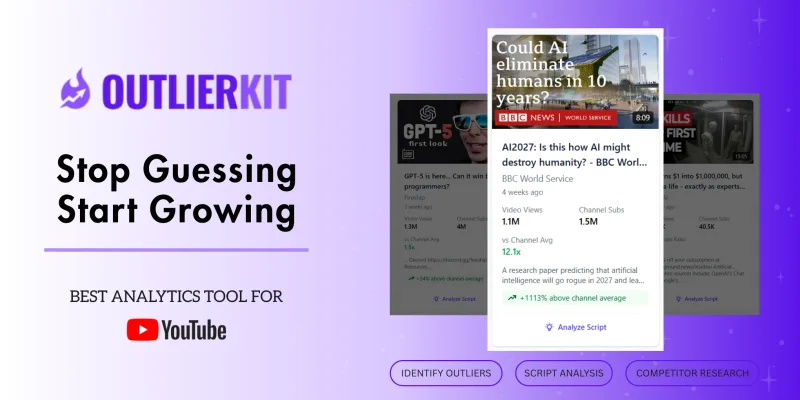
OutlierKit is a YouTube competitor analysis and outlier research platform that maps niche-wide opportunities from a single seed channel, surfaces overperforming videos, analyzes audience psychology, sponsors, and monetization, and offers AI-powered script/hook analysis and integrations for creators, teams, and agencies.