

Bearly
Bearly is a private AI workspace that provides encrypted, cross-platform tools for research, coding, content creation, team collaboration, and enterprise controls, with support for multiple large language models and developer tools.
Bearly is research software teams evaluate for education & research. Use this page to review pricing, integration signals, and the best alternatives before you commit.
Profile facts come from the vendor source. AiMatch labels unknown pricing or API details instead of estimating them.
Review official source →Quick Overview
Best for: Education & Research
What it does
Research software for decision-makers comparing workflow fit and alternatives.
Best fit
Education & Research
Pricing snapshot
Paid from Contact Bearly for pricing
Next step
Compare Bearly with similar tools before you shortlist it.
Compare this tool before you shortlist it
Review alternatives, pricing posture, and workflow fit side by side.
Bearly is presented as a private AI workspace focused on encryption, privacy, and cross-platform access. The product offers a workspace for research, coding, content creation, media processing, and team collaboration while emphasizing privacy (“Every chat and file individually encrypted. No ads, no training on your data.”). It targets individual and team workflows as well as enterprise deployments (SSO, SAML, permissions, spend controls) and supports multiple LLMs and developer tooling.
Bearly is a private AI workspace that provides encrypted, cross-platform tools for research, coding, content creation, team collaboration, and enterprise controls, with support for multiple large language models and developer tools.
Own this listing?
Claim this page for a one-time $29 to add pricing, features, screenshots, verified owner details, and a clearly labeled 30-day category position after the profile is live.
Claim this listing for $29Key Features
Agents & Customization
Agents: Cowork, skills, SDK, custom prompts and coding-focused agent capabilities.
Multi-model support
Support for a variety of models including Claude, GPT, Gemini, Grok, GLM, Kimi, and Minimax.
Research tools
Web and X search, deep research, document Q&A, and LLM councils for research workflows.
Code & Developer Tools
Code interpreters, artifacts, web apps, file generation, and SDK for developer workflows.
Creation suite
Create web apps, images, video, documents, and presentations.
Media features
Transcription, text-to-speech (TTS), image analysis, and OCR capabilities.
Memory & Search
Long-term recall, indexing, and vector search for persistent memory and retrieval.
Team & Collaboration
Projects, shared skills, and collaboration features for teams.
Enterprise controls
Enterprise features including SSO, SAML, permissions, policies, and spend controls.
Platforms
Available on desktop, mobile, browser extension, chat, and CLI.
Privacy & Encryption
Every chat and file individually encrypted; claims of no ads and no training on customer data; made and hosted in the U.S.
Pricing
Enterprise
Contact Bearly for pricing- SSO, SAML, permissions, policies, spend controls
- Team and collaboration features
Use Cases
Research & Knowledge Work
Web and X search, deep research, and document Q&A enable research workflows and information discovery.
Software Development & Coding
Code interpreters, artifacts, web apps, and SDK support coding, prototyping, and developer workflows.
Content & Media Creation
Create images, video, documents, presentations, and use media features like transcription and TTS for content production.
Team Collaboration
Projects, shared skills, and collaboration features allow teams to work together within the workspace.
Enterprise Deployment
Enterprise-grade access controls (SSO, SAML), permissions, policies, and spend controls for organizational use.
Integrations
Claude, GPT, Gemini, Grok, GLM, Kimi, Minimax
Support for multiple external LLMs/models to power AI features within the workspace.
Benefits
Limitations
No verified limitations are available.
Frequently Asked Questions
No verified FAQs are available.
Getting Started
- 1 Visit the Bearly website (https://bearly.ai/) and open the Docs or Download section.
- 2 Download the app for your platform (Mac, Windows, Linux, iOS, or Chrome extension) or use the CLI where available.
- 3 Use the Docs and SDK to configure agents, custom prompts, and integrate models or set up team and enterprise settings.
Support
docs
Documentation available on the Bearly website (Docs link shown in site navigation).
support
Support page referenced in site navigation (Support link shown in footer/navigation).
API
Compare Bearly with similar tools
See how it stacks up against alternatives
Related Tools
View all 135 →
ThoughtDAG
ThoughtDAG is an open-source, desktop-first application that makes LLM context visible, editable, and reproducible by representing context as an editable directed acyclic graph (wires = context) and letting users preview and control exactly what the model receives.

LLM Attention Visualization
A browser-based interactive visualization that shows how transformer LLMs allocate attention to past tokens during generation by aggregating attention weights and value magnitudes across heads and layers.
PilotCite
PilotCite is a SaaS platform that helps brands monitor and improve their visibility in AI-generated answers (ChatGPT, Perplexity, Google AI, Gemini, Claude, Copilot, Grok) by tracking citations, auditing site citability, benchmarking competitors, and generating source-backed content.

Knowledge graph skill for Claude/Kimi Code
SysEdge is an ontological knowledge graph and CLI for multi-agent Claude Code and Kimi Code teams that models requirements, tests, and architecture standards to surface specification, test, and standards gaps before code ships and to reduce agent orientation tokens.
Redactle LLM Leaderboard
A public benchmark dashboard that evaluates how well large language models (LLMs) solve Redactle puzzles by running standardized evaluations and publishing ranked results, costs, and performance metrics.
HieraticBench
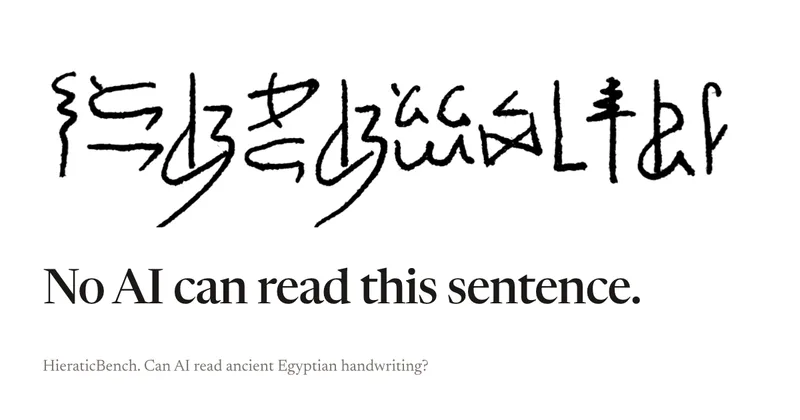
HieraticBench is an open benchmark for testing whether AI models can identify and read hieratic, the cursive handwriting of ancient Egypt. It includes a public leaderboard, evaluation harness, and dataset of documents and individual signs.
Budget-Friendly Alternatives
PilotCite
PilotCite is a SaaS platform that helps brands monitor and improve their visibility in AI-generated answers (ChatGPT, Perplexity, Google AI, Gemini, Claude, Copilot, Grok) by tracking citations, auditing site citability, benchmarking competitors, and generating source-backed content.
Knowledge graph skill for Claude/Kimi Code
SysEdge is an ontological knowledge graph and CLI for multi-agent Claude Code and Kimi Code teams that models requirements, tests, and architecture standards to surface specification, test, and standards gaps before code ships and to reduce agent orientation tokens.


Research on LLM Disagreement on Factual Claims
A 2026 open-access preprint reporting an empirical study that measures disagreement among five frontier large language models (LLMs) when adjudicating 1,000 real-world fact-checking claims; includes dataset, harness, and raw results.
Embench
Embench is a browser-based retrieval lab that lets you index a corpus and compare retrieval stacks (semantic, BM25 keyword, grep, hybrid, and reranked) side-by-side with inline evaluation metrics (precision, recall, MRR). It provides embedded open-source models and a stable JSON REST contract for runs.

Humata
Humata is an AI-powered document assistant that lets teams upload files (PDFs and other documents) and ask questions, summarize, compare, and retrieve cited answers from their knowledge base. It targets individual researchers and teams with tiered plans and enterprise-grade security.