Scribe
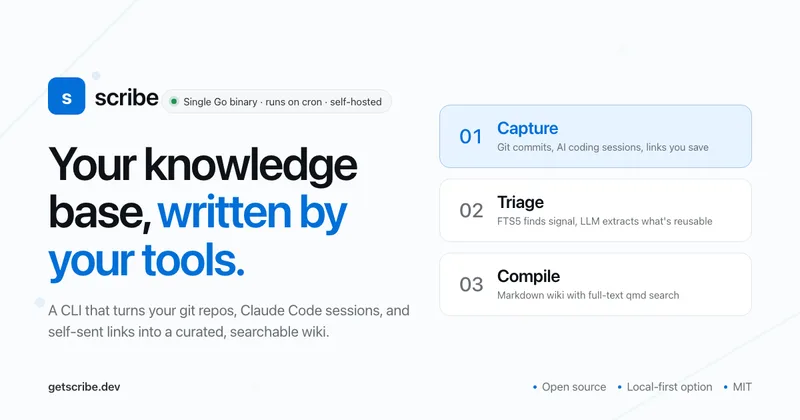
Scribe is a local-first CLI knowledge-base generator that automatically mines developer artifacts (git history, Claude Code & Codex sessions, self-sent URLs, and drop files), triages them with FTS5, and writes a cross-project, typed-graph markdown wiki in git for agents to read before they act.
Scribe is developer tools software teams evaluate for developer tools. Use this page to review pricing, integration signals, and the best alternatives before you commit.
Profile facts come from the vendor source. AiMatch labels unknown pricing or API details instead of estimating them.
Review official source →Used in These Packs
Quick Overview
Best for: Developer Tools
What it does
Developer Tools software for decision-makers comparing workflow fit and alternatives.
Best fit
Developer Tools
Pricing snapshot
Freemium from $0 (local-path example: run full pipeline against a local Ollama server)
Next step
Compare Scribe with similar tools before you shortlist it.
Compare this tool before you shortlist it
Review alternatives, pricing posture, and workflow fit side by side.
Scribe is a self-hosted CLI tool that continuously mines developer sources (git repos, Claude Code & Codex sessions, self-sent URLs, and drop files) on a cron schedule, filters noise with an FTS5 keyword-density triage, and runs a two-pass absorb to emit entity-first markdown articles. The output is a git-backed markdown wiki with YAML frontmatter, typed edges (10-kind schema), backlinks, and contextual paragraphs designed so agents (via CLAUDE.md / AGENTS.md handshake) read the KB before making decisions.
Designed for individual developers and small teams, scribe emphasizes local-first operation (100% Ollama support for zero API spend), portable markdown you own in git (no SaaS or vendor lock-in), and automated background operation via launchd/systemd/cron. It includes team-oriented governance (trust layer, secret-scan commit gate, allowed_remotes) so only curated knowledge crosses into a shared KB.
A single-binary CLI that turns your git repos, Claude Code and Codex sessions, and self-sent links into a curated, semantically searchable knowledge base. Cross-project, cron-driven, fully local-capable.
Own this listing?
Claim this page for a one-time $29 to add pricing, features, screenshots, verified owner details, and a clearly labeled 30-day category position after the profile is live.
Claim this listing for $29Key Features
Multi-stream capture
Mines four input streams on cron: git repositories, Claude Code & Codex sessions, self-sent URLs (iMessage), and drop files; auto-discovers projects you've opened in the agent CLIs.
FTS5 triage pre-filter
Keyword-density scoring with SQLite FTS5 rejects boilerplate sessions before any LLM call so cheap sessions cost nothing.
Two-pass absorb and entity-first fan-out
A first pass grounds atomic facts; a second pass fans dense sources into multiple entity-first wiki pages, producing typed markdown articles.
Typed graph & plain markdown output
Generates plain markdown files with YAML frontmatter, auto-wikilinks, backlinks JSON, and a closed 10-kind typed-edge schema (supersedes, contradicts, derived_from, specializes, extends, etc.).
Local-first inference (Ollama) or hosted providers
Per-op routing: run everything locally on Ollama for $0, or route specific ops to hosted providers (Together, Groq, Fireworks, Hugging Face) or Anthropic via claude -p.
Cron-driven autonomous loop
Install once and forget: hourly commits, periodic extraction, session mining cadence (3×/day), queued URL capture, and a weekly Dream consolidation (Sunday 02:00).
Agent handshake
Writes a maintained block into ~/.claude/CLAUDE.md and ~/.codex/AGENTS.md so every session queries the KB before recommending libraries or architectures.
Team governance and safety gates
Trust layer, secret-scan commit gate (regex-based), allowed_remotes, promote-with-provenance, and a committed leader lease to safely operate a shared KB without leaking secrets.
CLI-first install & diagnostics
Single Go binary with ~45 subcommands (install via Homebrew or shell installer) and diagnostic tooling (scribe doctor) for validating setup.
Pricing
Zero-cost local mode: run the entire pipeline against a local Ollama server for $0.
Local (Ollama)
$0 (local-path example: run full pipeline against a local Ollama server)- Full pipeline runs locally (extraction, absorb, dream, session-mine)
- No provider API spend
Hosted providers (Together, Groq, etc.)
Pay-per-op (example per-model pricing is configured in scribe.yaml; page shows example Together pricing mappings)- Per-op routing to hosted models
- User-provided API keys and pricing mapping in scribe.yaml
Anthropic (via claude -p or hosted Anthropic path)
Paid; example billing snapshot on the site showed ~$103.57 for a week of Anthropic usage in the sample run- Higher-quality models for pass-2 and consolidation
- Configurable per-op model pins
Use Cases
Developer session memory
Persist decisions, library evaluations, and fixes recorded in Claude Code / Codex sessions so future agent sessions find prior reasoning instead of re-deriving it.
Cross-project knowledge sharing
One cross-project KB lets an agent surface a fix or decision made in a different repository, reducing duplicate investigation across projects.
Team-curated shared KB
Small teams can point machines at a git-backed KB with governance controls (secret scanning, allowed_remotes, trust layer) to share curated knowledge safely.
Local, cost-controlled inference
Teams or individuals who want zero API spend can run the full pipeline on a local Ollama server; per-op routing allows selective hosted inference where desired.
Searchable developer wiki from any terminal
Index is exposed via qmd for BM25 and vector queries; query from any shell or inside Claude Code via MCP for ranked results and direct editor opens.
Integrations
Ollama
Local model server used to run the entire pipeline with zero API spend (one-line flip in scribe.yaml).
Claude Code (ccrider) & Codex CLI
Session sources: scribe mines Claude Code and Codex sessions (via ccrider and rollouts) for decisions and context.
qmd
Indexing and search: qmd provides BM25 full-text search and vector recall for the generated markdown corpus.
Git remotes (GitHub, Gitea, Forgejo)
Push the git-backed markdown KB to your own remote; scribe commit stages and pushes hourly auto-commits.
Benefits
Limitations
Frequently Asked Questions
How is scribe different from RAG, Obsidian, or claude-memory-compiler?
Does scribe require an Anthropic API key?
Can a team share one KB safely?
What does it cost to run?
Where does scribe store the knowledge base?
Does scribe run on Linux and macOS?
Getting Started
- 1 Install the binary (example): brew tap oliver-kriska/scribe && brew install oliver-kriska/scribe/scribe
- 2 Bootstrap a KB: scribe init --path ~/my-kb
- 3 Install the cron/agent hooks: cd ~/my-kb && scribe cron install && run scribe doctor to validate
Support
docs
Product site documentation and CLI reference at https://getscribe.dev/ and the README linked from the site.
issues
Project issue tracker on GitHub: https://github.com/oliver-kriska/scribe/issues
cli
Built-in diagnostics: use scribe doctor to validate setup, cron, git remote, and local-mode pipeline.
API
Compare Scribe with similar tools
See how it stacks up against alternatives
Related Tools
View all 147 →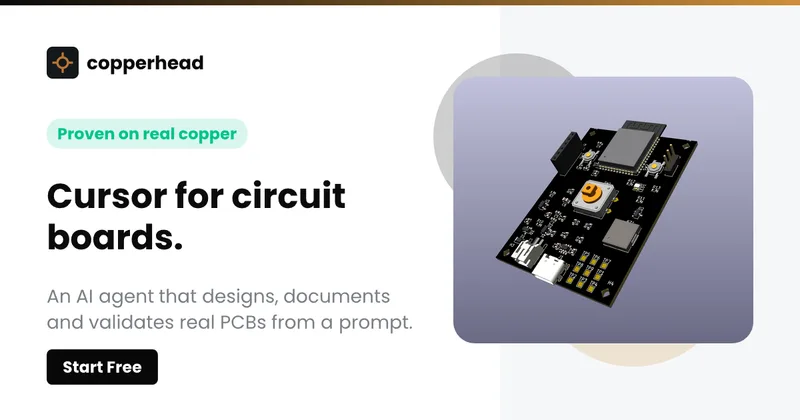
Copperhead
Copperhead is an open-source AI engineering platform and CLI that helps hardware teams design, verify, and ship printed circuit boards by editing KiCad files, running KiCad checks (ERC/DRC), and producing gerbers, firmware, and documentation in a gated, auditable pipeline.



Docs.dev Your Own Hosted Docs Platform in Minutes
Docs.dev is a deployable documentation template that runs as a Cloudflare Worker in your account, using your GitHub repo as the source of truth and agent-powered drafting (e.g., Claude Code or Codex) to generate reviewable docs branches that your team publishes via commit.
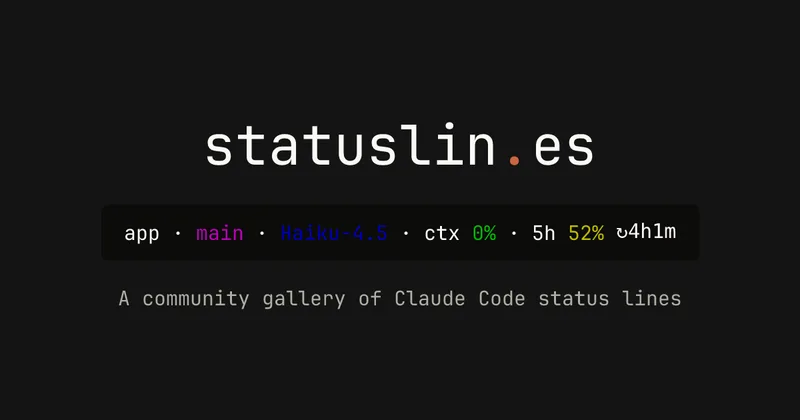
statuslin.es
statuslin.es is a community gallery of Claude Code status lines—copyable, previewed scripts and themes for terminal/status-bar displays that show Claude model stats (tokens, cost, limits), git info, and other runtime metrics.

Bullet · Fast, by design.
Bullet is a fast coding agent and developer tool that routes, searches, and executes code-focused tasks with a tight loop to minimize latency — offered as a macOS download and currently available in private beta.

Premium Alternatives
%22%2F%3E%20%3Ctext%20x%3D%2250%25%22%20y%3D%2250%25%22%20dominant-baseline%3D%22central%22%20text-anchor%3D%22middle%22%20font-family%3D%22system-ui%2C-apple-system%2Csans-serif%22%20font-weight%3D%22700%22%20font-size%3D%2250%22%20fill%3D%22white%22%3EO%3C%2Ftext%3E%20%3C%2Fsvg%3E)
OTP Inspired actor supervisor based full stack templates
ShipStacks provides production-grade, OTP-inspired full-stack SaaS templates that include supervisors/actor patterns, auth, payments, uploads, AI chat and agent playbooks, and Docker-ready deployment in multiple languages and frameworks.
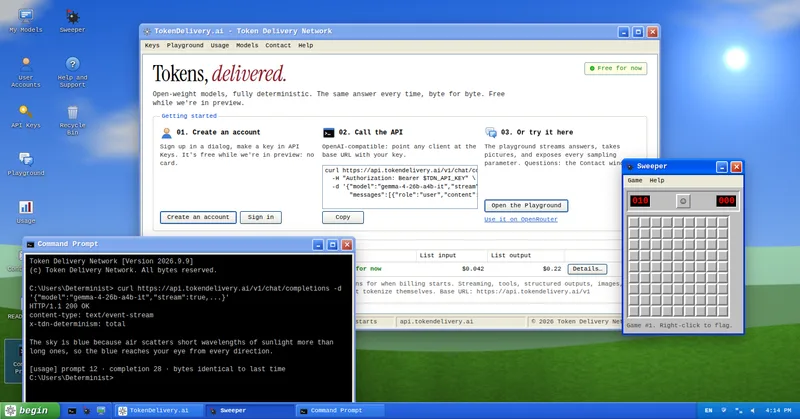
TokenDelivery.ai
TokenDelivery.ai (Token Delivery Network) is an OpenAI-compatible model API and playground that offers reproducible, deterministic model outputs, streaming responses, multimodal inputs (images and short videos), and exposed sampling parameters. It is free during preview and provides API keys, a playground, and a documented base URL for developers.

Servers for AI, not another AWS
RAW offers dedicated GPU and CPU servers specifically built for AI workloads — provision real metal with root access and CUDA via a single API. It emphasizes low cost (claims up to 100× cheaper than AWS), $0 egress, fast provisioning, and enterprise features for inference, training, agents, and vector databases.
StartKit.AI
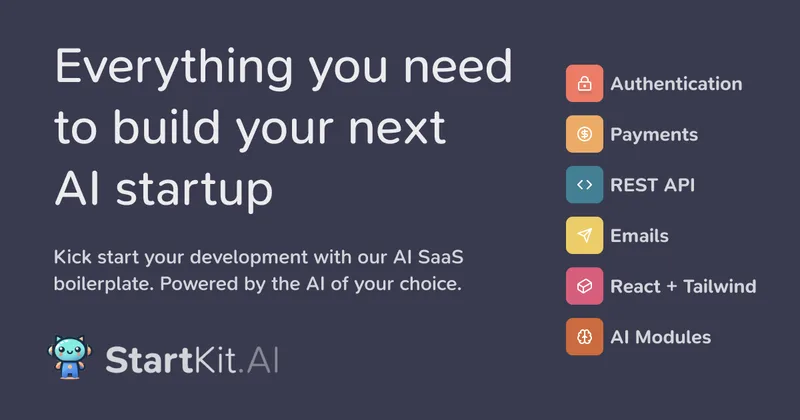
StartKit.AI is a purchasable, production-focused Node.js boilerplate that provides a complete SaaS app and pre-built AI modules to help developers ship AI startups quickly, including demos for chat, PDF, images, RAG, authentication, payments, and integrations with AI providers.