

Tachyon
Tachyon MCP is a Java and Kotlin server runtime for the Model Context Protocol (MCP) built on Netty that simplifies exposing tools, resources and agent skills; it handles transport, protocol details, task progress, and provides declarative annotated handlers for building MCP servers.
Tachyon is ai agents software teams evaluate for ai agents. Use this page to review pricing, integration signals, and the best alternatives before you commit.
Profile facts come from the vendor source. AiMatch labels unknown pricing or API details instead of estimating them.
Review official source →Used in These Packs
Quick Overview
Best for: AI Agents
What it does
AI Agents software for decision-makers comparing workflow fit and alternatives.
Best fit
AI Agents
Pricing snapshot
Pricing available from Free (Apache-2.0)
Next step
Compare Tachyon with similar tools before you shortlist it.
Compare this tool before you shortlist it
Review alternatives, pricing posture, and workflow fit side by side.
Tachyon MCP is a server runtime for the Model Context Protocol (MCP) implemented for Java and Kotlin, built on Netty. It lets developers write handlers (annotated or programmatic) while Tachyon manages transport, protocol handling, lifecycle and runtime concerns. The project includes quickstarts and examples for both Java (Maven/Gradle) and a Kotlin DSL, is released on GitHub, and is licensed under Apache-2.0.
Tachyon MCP is a production Model Context Protocol server runtime for Java and Kotlin. Netty transport, virtual threads, stateless by default, MCP 2025-11-25 and 2026-07-28 conformance.
Own this listing?
Claim this page for a one-time $29 to add pricing, features, screenshots, verified owner details, and a clearly labeled 30-day category position after the profile is live.
Claim this listing for $29Key Features
Model Context Protocol runtime
Provides a Java and Kotlin runtime for MCP, conformance-tested against MCP 2025-11-25 and 2026-07-28.
Netty-based transport & lifecycle
Netty owns sockets and connection lifecycle; Tachyon uses Netty for transport and lifecycle management.
Declarative annotated services and DSL
Support for annotated Java services and a Kotlin DSL to declare tools and handlers (examples show @McpTool and @McpParam usage and Kotlin DSL declarations).
Tools, prompts and completions
Built-in concepts for tools, resources, templates, prompts and completions to integrate agent capabilities and tooling.
Task support & progress notifications
TasksExtension provides task support (create_task + task://{id}), with server-side progress notifications and TaskSupport options (e.g., REQUIRED).
Skills extension
SkillsExtension can serve agent skills as skill:// resources from filesystem or classpath registries and supports optional negotiation.
Handlers on virtual threads or suspending Kotlin handlers
Run synchronous Java handlers on virtual threads or suspending Kotlin handlers; handlers do not run on the Netty event loop.
Observability
Documentation mentions observability and OpenTelemetry integration for monitoring.
Pricing
Free under the Apache-2.0 license (project releases available on GitHub).
Open-source
Free (Apache-2.0)- Source code and releases on GitHub
- Documentation and quickstarts
Use Cases
Build MCP servers in Java or Kotlin
Create Model Context Protocol servers using Tachyon's builder API, annotations, or Kotlin DSL and deploy via Netty.
Expose tools and long-running tasks to agents
Register tools (get_forecast, generate_report examples) with task support and stream progress notifications back to clients.
Serve agent skills and static skill resources
Use the SkillsExtension to serve SKILL.md and related files from filesystem or classpath registries as skill:// resources.
Integrate prompts and completions into agent workflows
Use built-in primitives for prompts, completions, templates and elicitation to support agent interactions and tool invocation.
Integrations
Netty
Underlying transport and connection lifecycle management is implemented on Netty.
TasksExtension
Provides create_task and task://{id} support and progress notifications for long-running operations.
SkillsExtension (Filesystem and Classpath registries)
Serve agent skills from filesystem or classpath registries and publish under namespaces.
OpenTelemetry
Observability support mentions integration with OpenTelemetry.
Benefits
Limitations
Frequently Asked Questions
No verified FAQs are available.
Getting Started
- 1 Choose Java (Maven/Gradle) or Kotlin DSL quickstart (see documentation).
- 2 Follow the quickstart to declare tools or annotated services (examples use TachyonServer.builder() or Kotlin DSL).
- 3 Build and run the server (examples show server.start() on port 8080) and test tool endpoints.
Support
docs
Documentation and guides available on the Tachyon site (Read the docs / Docs sections).
github
Project releases and source code available on GitHub (Releases on GitHub).
discord
Community/real-time discussion via Discord (page lists GitHub and Discord links).
API
Documentation and API usage examples are available on the Tachyon site (quickstarts and code samples like TachyonServer.builder()).
Compare Tachyon with similar tools
See how it stacks up against alternatives
Related Tools
View all 651 →
Needle2
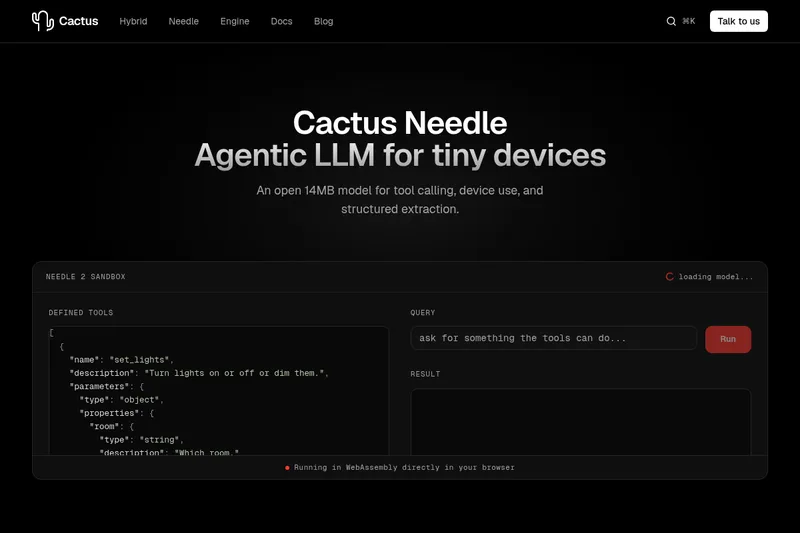
Needle 2 is an open, production-ready 45M-parameter agentic LLM from Cactus designed for tool calling, device control, and structured extraction on extremely small devices; the shipped CQ2-bit binary is ~14 MB and runs in ~28 MB of RAM across Cortex-M, microcontrollers, phones, Raspberry Pi and WebAssembly.

The cheapest GPU cloud
Compute Cheap provides low-cost GPU compute for training and inference, offering H100 and H200 SXM GPUs as interruptible or reserved capacity with published per-GPU-hour pricing and a simple request/reserve/run workflow.

Oodle.ai
Oodle Agent Observability provides agent/LLM observability at scale with S3-backed columnar storage, fast search (<1s P99), out-of-the-box AI-powered insights, and flat ingestion-based pricing designed to retain 100% of traces affordably for debugging and optimizing production agents.


Premium Alternatives
Abliterated LLM provider for cyber tasks
Refuseless hosts GLM 5.3 Abliterated models through an OpenAI-compatible API for cybersecurity and coding work. The page states that prompts are not retained and shows integrations with OpenCode and Pi.
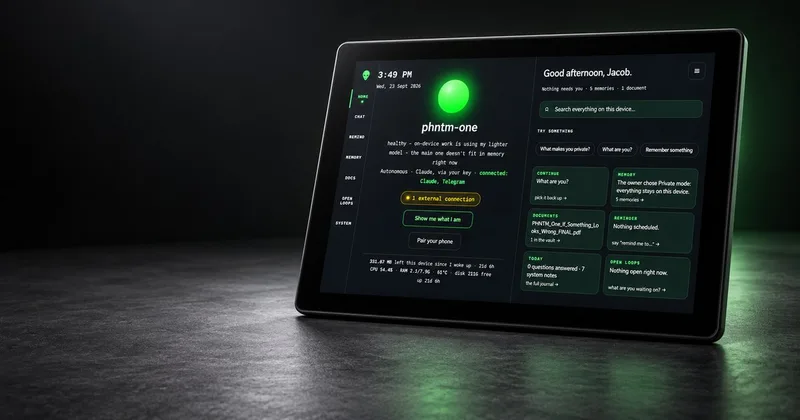
PHNTM ONE
PHNTM One is a private, local-first AI appliance: a hand-built desktop device (Raspberry Pi 5, 8 GB, 10.1″ touchscreen) that runs an on-device model (Gemma 3 4B) to provide a voice-capable assistant, memories, document reading, timers, Home Assistant integration and offline knowledge — sold as a one-time $549 purchase with no subscription and zero telemetry by default.
AletheionAGI
AletheionAGI provides a grounded-memory layer for AI systems that enforces evidence-bound delivery, namespace isolation, and policy authorization so AI readers cannot produce unsupported claims. It's targeted at production-facing use cases like customer support, commerce agents and internal copilots.

ClaudeThings
ClaudeThings provides a packaged, continuously-updating set of 89 specialized agents, 103 pre-built skills, and 181 slash commands that act as an AI engineering and marketing team for Claude Code — delivered as a private GitHub repo and installed with a single npx command. It adapts to any stack via a CLAUDE.md project manifest and is sold as a one-time purchase with lifetime updates.

bellmanloop
BellmanLoop is an AI-powered debt collection platform that automates and scales collections with compliance controls, multi-channel and multi-language support, real-time analytics, and SDKs for integration.
maccopilot
MacCopilot is a native macOS app that lets users select part of their screen and ask AI models about its contents. It connects to providers such as OpenAI, Anthropic, Google Gemini, Ollama, and compatible endpoints using the user’s own provider account or local server.