

magick
Magick is a visual IDE for designing, developing, and deploying AI agents using a node-based interface. It emphasizes open-source extensibility, platform-agnostic LLM choice, document processing, and scalable deployments for both rapid prototyping and production use.
magick is ai agents software teams evaluate for ai agents. Use this page to review pricing, integration signals, and the best alternatives before you commit.
Profile facts come from the vendor source. AiMatch labels unknown pricing or API details instead of estimating them.
Review official source →Used in These Packs
Quick Overview
Best for: AI Agents
What it does
AI Agents software for decision-makers comparing workflow fit and alternatives.
Best fit
AI Agents
Pricing snapshot
Paid from Usage-based metered billing; pay for resources consumed (no specific rates listed)
Next step
Compare magick with similar tools before you shortlist it.
Compare this tool before you shortlist it
Review alternatives, pricing posture, and workflow fit side by side.
Magick is a visual, node-based IDE for creating, testing, and deploying intelligent AI agents. The platform is positioned as open-source and community-driven, allowing contributors to customize and extend its capabilities, while providing documentation and a GitHub presence for deeper engagement. Magick targets both rapid prototyping and production deployments, offering platform-agnostic integration with multiple LLMs and tools to build domain-specific assistants and event-driven, real-time agent behavior.
Visual IDE for building and deploying AI Agents with a low-code interface.
Own this listing?
Claim this page for a one-time $29 to add pricing, features, screenshots, verified owner details, and a clearly labeled 30-day category position after the profile is live.
Claim this listing for $29Key Features
Visual Node Builder
Drag-and-drop node-based interface to design AI workflows and agent behavior without writing code.
Open-Source Flexibility
Community-driven development model with GitHub visibility for contributing, customizing, and extending functionality.
Platform Agnostic LLM Support
Ability to integrate and compare different models (e.g., GPT-4, Claude, or open-source alternatives) to optimize performance for each task.
Powerful Document Processing
Tools for handling and analyzing complex documents and datasets to extract insights, summarize content, and embed knowledge into agents.
Rapid Prototyping
Real-time iteration and testing within the IDE to quickly build and refine agent behavior and turn concepts into prototypes.
Deep Customization
Support for fine-tuning models, creating custom nodes, and tailoring behavior to specific requirements and business needs.
Real-Time & Event-Driven
Create agents that react to events and user interactions, with real-time testing and refinement in the AIDE.
Scalable Deployment
Architecture designed to scale agents to growing user bases and workloads, intended for production use.
Multi-Platform Integrations
Connect agents to platforms and tools such as Discord, Unreal Engine, Google AI services, and custom APIs.
Comprehensive Tooling
End-to-end tooling for building, testing, debugging, and monitoring agents through the full AI development lifecycle.
Metered Billing
Usage-based, metered billing model that charges for resources consumed to support incremental growth.
Pricing
Metered Usage
Usage-based metered billing; pay for resources consumed (no specific rates listed)- Resource-based billing that scales with usage
- Transparent metered model to start small and grow
Use Cases
Domain-specific AI Assistants
Build assistants that use embedded knowledge and document processing to answer questions and support workflows.
Chatbots and Platform Bots
Deploy conversational agents and bots for platforms like Discord using the platform integration capabilities.
Game NPCs and Interactive Characters
Create responsive NPC behaviors in game engines such as Unreal Engine by integrating Magick agents into game environments.
Document Analysis and Summarization
Process and summarize complex documents and datasets to extract insights and generate responses informed by embedded knowledge.
Rapid Prototyping of AI Workflows
Quickly design and iterate on agent logic and integrations to validate ideas and move to production faster.
Integrations
LLMs (GPT-4, Claude, open-source models)
Enables selection and comparison of different language models to optimize task performance.
Discord
Build and deploy bots that operate on Discord as an example platform integration.
Unreal Engine
Integrate agents as NPCs or interactive characters within Unreal Engine environments.
Google AI services
Integration with Google AI services for extended capabilities.
Custom APIs
Connect agents to bespoke APIs to enable custom data flows and external integrations.
Benefits
Limitations
No verified limitations are available.
Frequently Asked Questions
No verified FAQs are available.
Getting Started
- 1 Visit the Magick documentation linked on the site to review guides and reference material.
- 2 View the project on GitHub to access source code, examples, and contribution instructions.
- 3 Try the product via the website (site indicates a beta/try option) and begin building agents in the visual node builder.
Support
Documentation
Official product documentation linked on the site for guides and developer reference.
Community / GitHub
View the project on GitHub to access source code, raise issues, and contribute to the project.
API
Compare magick with similar tools
See how it stacks up against alternatives
Related Tools
View all 629 →
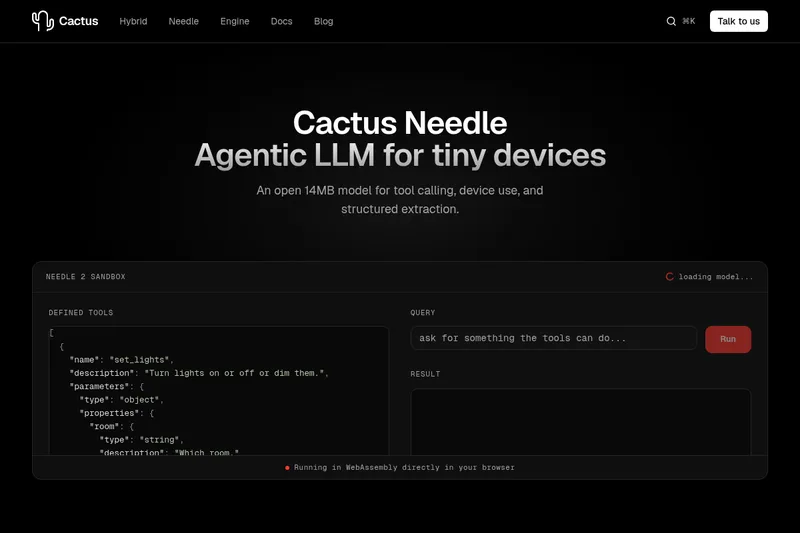
Needle2
Needle 2 is an open, production-ready 45M-parameter agentic LLM from Cactus designed for tool calling, device control, and structured extraction on extremely small devices; the shipped CQ2-bit binary is ~14 MB and runs in ~28 MB of RAM across Cortex-M, microcontrollers, phones, Raspberry Pi and WebAssembly.
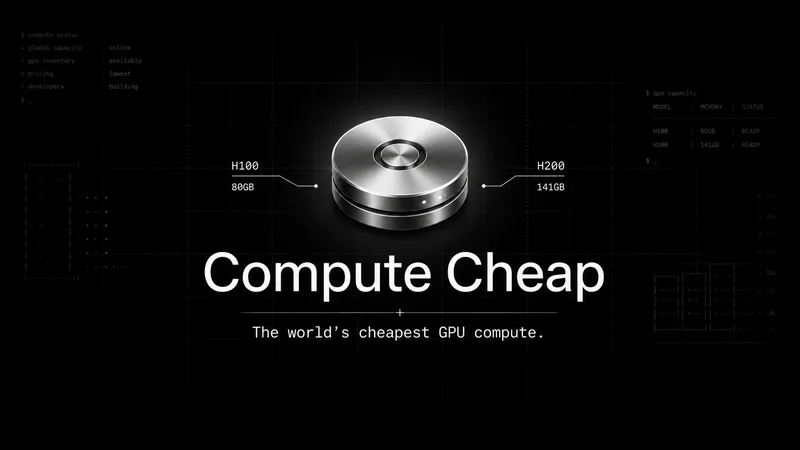
The cheapest GPU cloud
Compute Cheap provides low-cost GPU compute for training and inference, offering H100 and H200 SXM GPUs as interruptible or reserved capacity with published per-GPU-hour pricing and a simple request/reserve/run workflow.

Oodle.ai
Oodle Agent Observability provides agent/LLM observability at scale with S3-backed columnar storage, fast search (<1s P99), out-of-the-box AI-powered insights, and flat ingestion-based pricing designed to retain 100% of traces affordably for debugging and optimizing production agents.


Budget-Friendly Alternatives
The cheapest GPU cloud
Compute Cheap provides low-cost GPU compute for training and inference, offering H100 and H200 SXM GPUs as interruptible or reserved capacity with published per-GPU-hour pricing and a simple request/reserve/run workflow.
Oodle.ai
Oodle Agent Observability provides agent/LLM observability at scale with S3-backed columnar storage, fast search (<1s P99), out-of-the-box AI-powered insights, and flat ingestion-based pricing designed to retain 100% of traces affordably for debugging and optimizing production agents.
%22%2F%3E%20%3Ctext%20x%3D%2250%25%22%20y%3D%2250%25%22%20dominant-baseline%3D%22central%22%20text-anchor%3D%22middle%22%20font-family%3D%22system-ui%2C-apple-system%2Csans-serif%22%20font-weight%3D%22700%22%20font-size%3D%2250%22%20fill%3D%22white%22%3EL%3C%2Ftext%3E%20%3C%2Fsvg%3E)
